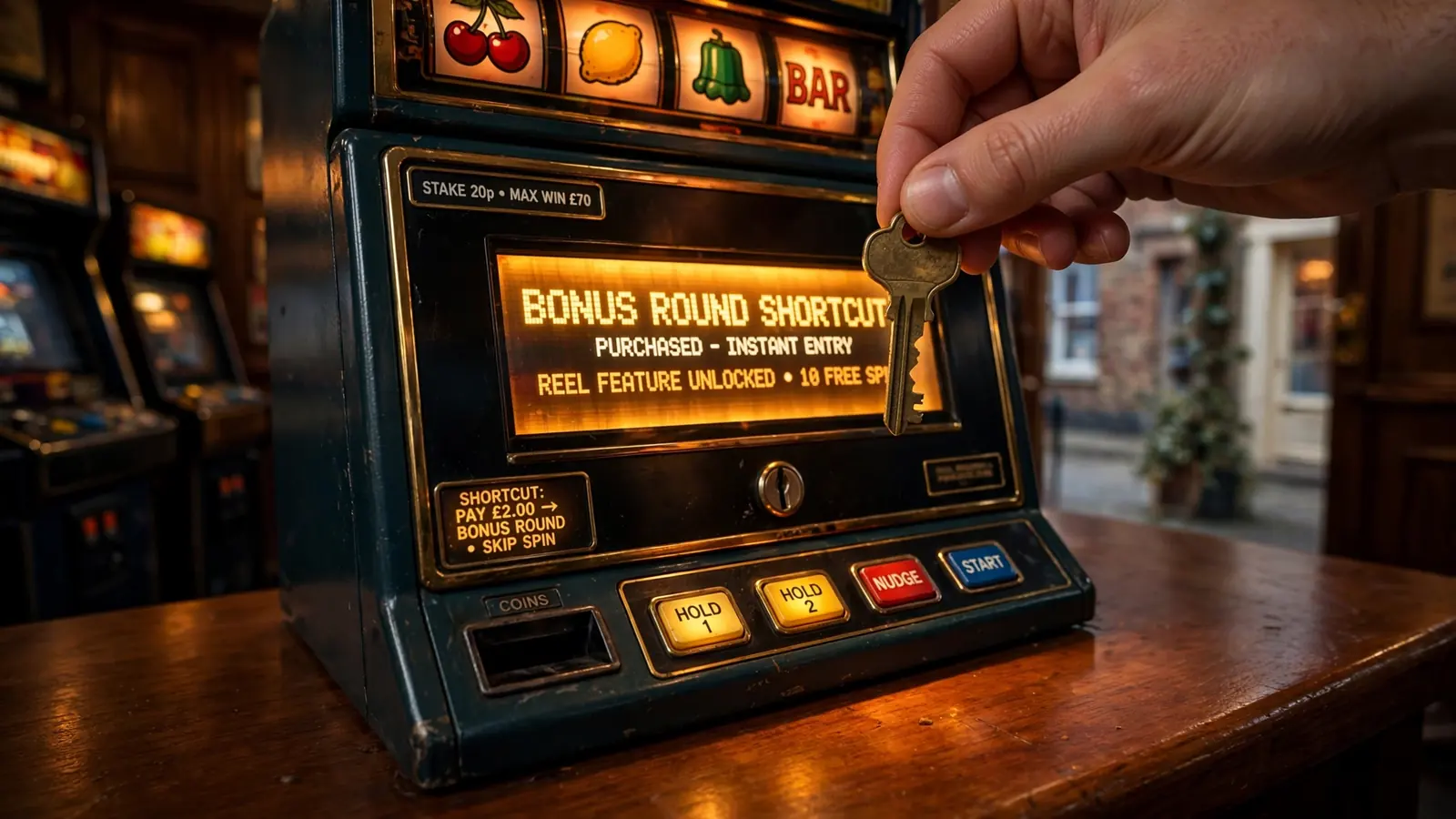
A bonus buy provides direct access to a game’s bonus round, but does not determine the symbols or outcome that follow.
What a Bonus Buy Changes Inside a Slot
An ordinary spin starts a game cycle and gives the slot a chance to produce a winning combination or trigger a feature. If a bonus round is available through normal play, you have to wait for the game’s stated trigger conditions to occur. A bonus-buy feature changes that route: where the game offers it, you can pay to enter the bonus round directly instead of relying on a regular spin to trigger it.
That changes how you reach the feature, not the basic role of chance. A buy does not turn the bonus round into a known result. It provides access to a particular part of the game, while the outcome inside that part remains uncertain. The game still determines which symbols, events or other results appear. So a bonus buy is not equivalent to spinning until a bonus happens, nor is it a way to select the result you will receive.
The distinction matters because a normal spin and a bonus buy are separate ways of entering the game’s outcome process. During ordinary play, the spin can return a prize, produce no prize, or meet a condition that opens a bonus round. With a buy option, the game bypasses that wait and starts the bonus feature according to its rules. The ordinary route includes the possibility of reaching the feature as part of a spin; the purchase route is specifically for entering it.
Volatility shapes the return pattern
Volatility describes how a slot distributes its results over play. It is about the pattern of wins, not a promise about what will happen in a particular session. A low-volatility slot tends to return value through many smaller wins. A high-volatility slot tends to pay less often, with larger amounts when wins do occur. Neither description tells you when a win will arrive or how large a particular result will be.
Fast Payout Online Casinos in the UK: What to Know
This affects how a bonus-buy slot may feel over repeated play. A game with frequent, modest returns can produce a steadier sequence of outcomes, while a more volatile game can have longer stretches without a win and sharper changes when a larger result arrives. Those are broad tendencies, not a schedule. Even a game that often produces small returns can have an unbroken run of losing results, and a high-volatility game does not owe you a large win after a quiet spell.
A bonus buy brings this return pattern into focus because it takes you directly to a feature rather than making you pass through ordinary spins first. If the feature’s results are variable, a single purchase can end in a small return, a larger return or no return. The direct entry does not remove the spread of possible outcomes. It only changes which part of the game you enter and when.
It is also important not to treat the amount paid for entry as a forecast of the result. The cost is the price of accessing the feature, not evidence that the feature will return that amount or more. How the slot calculates its outcomes depends on the game’s design; the word “buy” does not imply that you are purchasing a win of a particular size.
A different route does not change the long-run maths
A slot’s house edge describes the mathematical advantage built into the game over a sufficiently large number of plays. Where a game has a positive house edge, its mathematical expectation for the player is negative over enough sessions. That remains true whether results arrive as frequent small wins or as less frequent, larger ones. A gradual pattern can make losses less conspicuous for a time, but it does not remove the underlying expectation.
The same distinction applies when you enter a bonus round directly. A buy feature does not reverse the game’s mathematical structure merely because it skips the usual trigger. Nor can a short run establish that a slot has become favourable: random outcomes can vary widely in the near term, particularly when returns are unevenly distributed.
Feature Access Direct entry to bonus rounds
Mathematical Nature Uncertain outcomes and house edge remain
Return Pattern Determined by slot volatility
When comparing bonus-buy slots, then, separate two questions. First, what route does the game provide into its bonus round? Second, what kind of return pattern does the game have? The first concerns access; the second concerns how outcomes are distributed. Confusing them can make a direct entry seem more predictable than it is. A bonus buy changes the path into a feature, while volatility and the game’s underlying mathematics continue to shape the possible results.
What to Check Before Using a Bonus Buy at a UK Casino
Before choosing a casino with bonus-buy slots, check the operator as well as the game. A slot’s buy feature belongs to the game; a casino bonus is an offer made by the operator. The shared word “bonus” does not make them the same product, and accepting a promotional offer does not itself activate a slot feature.
Confirm the operator’s licence
For customers in Great Britain, remote gambling operators must hold the relevant UK Gambling Commission licence, even if their equipment or business operations are based elsewhere. The Commission is the sole regulator for commercial gambling in Great Britain. A casino’s website address, branding or claim that it is “UK-friendly” does not establish that it is licensed to serve British customers.
Check the operator’s licence number against the Gambling Commission’s public register before depositing. Confirm that the registered business matches the company named on the casino site and that its licence status is current. If the names do not match, or the operator cannot be identified clearly, pause rather than treating a logo or licence claim as proof. A licence is relevant to the operator, not a guarantee that every game or promotional offer will suit you.
Video Slots in the UK: Reels, Paylines and Play
This check matters whether you are looking for an online casino where you can buy a slot bonus or simply browsing a casino’s game catalogue. The feature may appear in a game, but the operator is responsible for offering remote gambling to customers in Great Britain under the applicable regulatory framework. A casino’s location does not remove that requirement.
Separate the game feature from the casino offer
A bonus buy is an option associated with a particular slot. A casino bonus, by contrast, is an operator promotion, which may have conditions separate from the game’s own rules. One does not imply the other: a casino can offer a slot with a buy feature without giving you a promotional bonus, and a promotional offer does not mean that a particular slot includes a buy option.
Read the promotion’s terms before accepting it. Check what the offer applies to, how it is credited, what conditions govern its use and whether any restrictions affect the games you intend to play. Do not assume that a slot’s feature purchase counts as qualifying activity for a promotion. If the terms do not clearly explain how the offer interacts with a game feature, ask the operator before opting in.
An affiliate review reports a 48-hour lifespan for bonuses, but that is not a rule you should apply to every casino offer. The expiry period and other conditions are determined by the particular promotion. Use the terms displayed by the operator for the offer you are considering, and check them at the time you accept it rather than relying on a general description elsewhere.
DO
- Check the operator’s UK Gambling Commission licence
- Read the full terms of any casino promotion
- Use demo play to inspect the game interface
DON’T
- Assume a “bonus buy” guarantees a specific payout
- Treat a casino bonus and a slot feature as the same thing
- Rely on affiliate reviews for specific promotion expiry rules
Check account and payment conditions
A licensed operator must verify your age before allowing you to deposit. Online gambling in the UK is for people aged 18 and over at sites holding a UK Gambling Commission licence. The operator must also prompt new customers to set a financial limit before their first deposit and provide accessible controls for managing account-level limits. These are account safeguards; they are separate from the price or rules of a slot feature.
UK-licensed casinos cannot accept credit-card payments for gambling. This includes credit-card funding routed through a money service business, and operators cannot accept wallet payments where the wallet allows credit-card funds to be used for gambling. If a cashier or payment description is unclear about the source of funds, check with the operator instead of assuming that a particular route is permitted.
Judge the offer on its written terms
Promotional wording can make an offer sound broader than its conditions. Read the full terms for the promotion you are considering, not only a banner or short summary. Pay attention to the stated eligibility, applicable games, any expiry condition and the steps required to claim or use the offer. If a condition is missing or ambiguous, treat that as a reason to seek clarification, not as permission to assume the most favourable interpretation.
3-Reel Slots in the UK: Format, Bets and Odds
Keep the two decisions distinct: first, whether the operator is licensed to serve customers in Great Britain; second, whether its separate promotional offer is clear and appropriate for you. Only after those checks does it make sense to consider whether the casino’s catalogue includes the slot feature you want. A “casino bonus buy” label alone tells you neither that the operator is properly licensed nor that a promotional bonus and a slot’s buy feature are connected.
What Free Bonus-Buy Demos Let You Test
A free demo gives you a way to inspect a slot’s presentation before putting money into an account. You can see the reel area, the information panels and, where the demo includes it, the bonus-buy control. This makes a free bonus-buy demo useful for checking whether the feature is visible and how the game presents it, without risking a deposit.
Demo play uses fake money, not funds you can withdraw. Any balance or win shown during the session is part of the simulation; it does not create a real-money payout. Treat the display as a view of the game’s interface, not as a source of cash or a record of a paid session.
What the interface reveals
The demo can show how the slot arranges its reels and other on-screen elements. You can inspect whether the bonus-buy option appears alongside the regular game controls, whether it is labelled clearly, and where the game displays information about the feature. That can help you understand the screen layout before encountering the same game in real-money play.
Demo play uses simulated funds and does not provide a record of real-money outcomes or payouts.
The presentation varies between titles. A game may make the feature easy to locate, while another may place it in a menu or provide information in a separate panel. A demo can let you examine that presentation at your own pace. It does not establish that every slot has a bonus-buy option, or that a feature will be available in every version of a game.
You can also observe how the game communicates its rules. Look for the help or information area and note whether it explains the slot’s symbols, round structure and feature labels. The value of this inspection is practical: unfamiliar terms or controls are easier to recognise when you are not making a paid decision at the same time.
What it cannot reproduce
Free play is not the same as playing real money slots with a real balance. The demo’s balance is simulated, and no payout is awarded. A displayed result therefore has no cash value, even if the game shows a win animation or updates its on-screen total.
The demo also cannot establish what a paid session would return. Seeing a feature appear, or seeing a particular result in free play, does not predict what will happen in a later session. The demo is a way to view the game’s design and interface, not evidence of a reliable pattern of real-money outcomes.
Availability may also depend on the game or the platform showing it. If a title opens in demo mode but the bonus-buy control is absent, that does not by itself show that the paid version lacks the feature; the free version may present only part of the game. Check the game’s own information where available rather than assuming that every screen or control is identical across versions.
Best RTP Casino Slots UK: Returns and Volatility
Use a demo to become familiar with what is on screen and how the game labels its features. Keep the distinction clear: free play lets you inspect a simulation, while real-money play involves money at risk and can produce outcomes the demo cannot forecast.
What You Are Buying When You Buy a Slot Bonus
A bonus buy is a paid option that gives you access to a slot’s bonus feature without waiting for the usual in-game trigger. The purchase changes how you enter that feature; it does not purchase a particular result. Once the bonus begins, its outcome still depends on the game’s rules and randomised result.
This distinction matters because “buying the bonus” can sound like buying a win. You are not paying to receive a fixed payout or a guaranteed profit. You are paying for the opportunity to play a bonus round, where the result may be worth more or less than the cost of entry. It may also return nothing.
The feature and the round are separate parts of the process. The buy option is the entry mechanism. The bonus round is the game sequence that follows, with its own rules for symbols, prizes and any multipliers. A multiplier can increase wins accumulated during that round, but it does not make a win certain. If there is no qualifying win to multiply, the multiplier cannot turn the purchase price into a guaranteed return.
Attention The cost of a bonus buy is the price of accessing the feature, not evidence of the amount you will win.
A useful way to read the cost is as the price of access, not as the value of the result. Compare that cost with the stake you normally use and consider what you would be willing to lose if the round produces no payout. The displayed purchase price does not predict what the round will return, and a large possible multiplier is not the same as a likely outcome.
Game descriptions may also link bonus mechanics to the slot’s wider design. For instance, low-volatility slots commonly use bonus rounds that apply multipliers to wins accumulated during the round. The multiplier operates on those wins; it does not apply automatically to the purchase price or guarantee that the round will create a sizeable accumulated win. The same wording can therefore describe different experiences depending on what the game counts and when it applies the multiplier.
When you assess a buy option, identify exactly what the game says the purchase unlocks. Check whether the bonus has its own stages, what counts as an accumulated win, and how any multiplier is applied. These details define the feature more accurately than a headline prize or the word “bonus” on its own.
So, when you buy a bonus in a slot, you buy access to a specified game feature. You do not buy a predetermined payout. Treating the transaction that way makes the cost and the uncertain result easier to distinguish: the first is set by the game, while the second is produced by the bonus round.
Best High-RTP Slots in the UK: How RTP Works
How Reel Layout and Volatility Shape Bonus-Buy Slots
A slot’s layout determines how symbols can form winning combinations; its volatility describes the pattern in which returns tend to arrive. Both affect what you are assessing when comparing games that offer a bonus-buy feature. Neither tells you what a particular play will return.
Start with the reels and paylines. A five-reel slot can apply a bet across all five reels, but the reel count alone does not show how many combinations can qualify as wins. Paylines specify the paths or patterns the game recognises. A layout with many paylines can count more patterns than one with fewer, while the game’s rules determine which symbols and positions qualify on each line. Check those rules rather than assuming that a larger layout means better results.
Low-volatility slots tend to distribute returns across more frequent, smaller wins. Across most titles, winning combinations in these games typically occur every three to six spins on average; that is a broad pattern, not a schedule for any individual session. Higher-volatility slots tend to pay less often, with larger amounts when wins do occur. A quiet run is therefore more consistent with the latter pattern, but it does not predict when a larger win will arrive.
This distinction matters when a bonus-buy option is available. Buying access to a feature does not change the underlying volatility into a promise of frequent returns or a particular payout. The game’s rules and return pattern still shape the possible outcomes. A bonus-buy slot may have a layout that looks familiar, yet its volatility can make the experience markedly different from another title with a similar number of reels.
Understanding the Feature
A bonus buy provides a faster route to a feature, but does not change the underlying mathematical volatility or house edge.
Some lower-volatility games commonly use five reels and twenty-five or more paylines. That is a design tendency, not a rule that every game follows. Compare the paytable and the stated volatility together: the paytable explains what combinations count and what they pay, while volatility gives a broad indication of how wins are distributed over time. Look at both before deciding whether the game’s structure suits the kind of play you want.
The practical comparison is not simply between a compact and a complex layout. It is between the rules that define winning patterns and the return pattern those rules produce. A higher number of paylines does not remove the uncertainty created by volatility, and more frequent small wins do not establish that a slot will return a profit over a session.
Our top casino picks for the UK
- DieselwinBonus: Welcome Pack 250% up to £4000 + 200 FS · Payout speed: 1-3 business days
- SpinFormulaBonus: 550% Up To £15,000 + 550 FS · Payout speed: 1-3 business days
- x3betBonus: Welcome Pack 100% Up to £1.000 + 200 Free Spins · Payout speed: 1-3 business days
- BeOnBetBonus: 100% up to €500 + 100 FS · Payout speed: 1-3 business days
- BritsinoBonus: Welcome Package – Get your £2,200 + 2,000 FS · Payout speed: 1-3 business days
- ChanzeBonus: Slots Welcome Bonus #1 200% up to €500 · Payout speed: 1-3 business days
- SlotoSportBonus: 500% up to £ 10 200+ 777 FS · Payout speed: 1-3 business days
- WinBeastBonus: €5000 + 500 FS + €650 Freebet · Payout speed: 1-3 business days
- Revery PlayBonus: 100% up to€1,000+ 100 FS · Payout speed: 1-3 business days
Bonus-Buy Casinos and the GamStop Question
A casino offering bonus-buy slots and a casino’s relationship with GamStop are separate matters. The bonus-buy feature belongs to an individual game; GamStop is a self-exclusion scheme. Whether a casino appears on GamStop does not, by itself, establish whether it is authorised to offer gambling to customers in Great Britain.
The relevant regulatory check is the operator’s status with the UK Gambling Commission. The Commission regulates gambling in the United Kingdom, including online casinos, and issues operating licences to businesses. A business serving the British market must hold the relevant operating licence. A personal licence, by contrast, applies to an individual working in the gambling industry; it is not a substitute for the business’s operating licence.
Online Slots Payout Percentage: How It Works
Before depositing, find the operator’s legal business name and licence details, then check the licence number against the Commission’s public register. Confirm that the registered business is the one behind the casino and that its authorisation covers the activity being offered. A logo or statement on a casino website is not the same as checking the register. If the details do not match, or you cannot establish which business operates the site, do not treat the site as verified.
This distinction matters when considering a bonus-buy casino described as “not on GamStop”. That description says something about the casino’s connection to the self-exclusion scheme; it does not prove that the operator holds a British licence, and it does not make an unlicensed site safe or suitable. Nor should searching for a casino outside GamStop be treated as a way to get around a self-exclusion decision. If you have excluded yourself, choosing another site to continue gambling would undermine the protection you set up.
A bonus-buy casino demo is a different issue again. A demo may let you inspect a game without depositing, but it cannot establish the operator’s licensing status. Check the casino and the game separately: the demo is a way to view the slot, while the register check concerns the business offering gambling. Do not infer that a site is regulated because a familiar game is available there.
Operator Verification
- Match the business name to the Gambling Commission register
- Confirm the licence status is current
- Ensure the operator is authorised for the UK market
The practical test is not whether the casino uses a particular label or carries a bonus-buy catalogue. It is whether the named business can be matched to a current Gambling Commission operating licence for the relevant market. Keep the GamStop question separate from that check, and do not use absence from the scheme as a recommendation to gamble elsewhere.
How to Compare Bonus-Buy Games Without a Promised Top List
A catalogue can help you identify bonus-buy slots, but a title’s position on a page does not establish that it is better than the titles around it. Treat the catalogue as an index: use its labels to find relevant games, then compare the information shown for each one. A new release is not automatically a better match for you than an older title.
Start by checking whether the game explicitly offers a bonus-buy feature. Do not infer this from artwork, a bonus-round symbol or a general description of the game. If the catalogue provides a feature filter, use it to narrow the selection; then confirm the feature in the game’s own information. Availability and presentation can differ between titles, so a broad “bonus” label may not tell you whether direct access to a round is included.
Games: UK Online Casino Games and Slots
Next, note how the catalogue describes the game’s structure. Reel count and payline information can help you distinguish one layout from another, provided those details are actually displayed. A 5 reel slot game might present a familiar grid, while another title may use a different arrangement. Pay attention to whether paylines are fixed or selectable if the game information explains this. Do not treat a larger number of lines as proof of stronger results; it describes the layout, not what a session will return.
Bonus descriptions are useful when they state what happens in the round rather than relying on promotional wording. Look for an explanation of the feature’s mechanics, such as whether wins can be affected by multipliers. For instance, low-volatility slots are often described as having five reels, at least twenty-five paylines, fixed jackpot amounts rather than progressive pools, and bonus rounds using multipliers on accumulated wins. Those characteristics describe a pattern found in that type of game, not a guarantee that every title with those features will behave identically.
Golden Sevens is one title you can use as a catalogue entry to examine the information provided. Its name alone cannot establish its volatility, layout or bonus-buy availability; check the title’s own details for those points rather than filling gaps with assumptions.
When comparing newer releases, apply the same checks as you would to any other game: confirm that bonus buy is stated, inspect the layout details and read how the bonus round is described. If a catalogue omits a detail, regard it as unknown rather than guessing from the title or promotional image. That gives you a consistent basis for narrowing your options without turning an unsupported ranking into a supposed best-games list.
Comparing Game Catalogues
When using a catalogue, do not assume a title’s position implies it is better. Use labels to find bonus-buy features, check the reel layout, and read how the bonus round mechanics are described to make an informed comparison.
How to Use a Bonus-Buy Feature in a Slot
A bonus-buy control is part of the game interface, if the title offers the feature. It may appear near the reels or among the game’s other controls, but its position and label are not standard across slots. Read the on-screen wording rather than assuming that a button in one game works the same way in another. If no purchase option is displayed, do not assume the feature is available.
Before selecting it, check what the game says the purchase will cost. The amount may be shown beside the control or in a confirmation panel. Make sure you can distinguish that cost from the ordinary spin stake: choosing the feature is a separate decision, and the displayed purchase price is the amount at risk for that choice. If the game shows further details before confirmation, read them before proceeding.
Then consider the cost against the stake you intend to use and the amount you have chosen to spend. A feature purchase does not make the result predictable, so do not treat its price as a forecast of what the bonus will return. If the cost is unclear, or you cannot tell whether a screen is asking you to buy the feature or make a regular spin, cancel or leave the game rather than confirm.
A specialist casino review describes the applicable British online-slot limits as £5 per game cycle for customers aged 25 and over and £2 for those aged 18 to 24. These limits concern the amount staked in a game cycle; they do not mean that every feature purchase costs the same, or that the displayed price should be ignored. Check the game’s own purchase screen and keep your decision within the amount you have set for play.
When the game asks you to confirm, pause and check the action and cost once more. Confirm only if both are clear and you still want to proceed. If you select the wrong control, do not assume the game will reverse the action automatically; follow the information shown on screen. A purchase may start the feature immediately, so make the decision before pressing the final confirmation control.
There is no universal sequence of buttons for buying a bonus on a slot machine. The reliable method is to identify the in-game purchase option, read its displayed cost, consider that cost alongside your stake and spending limit, and confirm only when the screen clearly shows the action you intend.
What a Free-Play Session Can and Cannot Tell You
A free-play session can show whether a slot’s interface is understandable and how it responds to your choices. It cannot show what a real-money session will pay. Demo play uses fake money, and it awards no real-money payouts, so its results are observations about the game’s presentation, not evidence of future earnings.
Pay attention to what the screen makes clear: whether the bonus-buy option is visible, what information appears before you select it, and how the game displays the outcome afterward. You can also observe whether the controls respond as expected and whether the sequence is easy to follow. These are useful interface checks. They do not establish that the game will behave identically in every session or that a particular outcome is likely to recur.
Does a bonus buy guarantee a win?
No. A bonus buy provides access to the bonus round, but the outcome inside that round remains uncertain and is determined by the game’s random results.
How does volatility affect a bonus buy?
Volatility describes the pattern of wins. Buying a feature does not change the volatility; a high-volatility game may still have long stretches without a win, even if you enter the feature directly.
Can I use a demo to predict real winnings?
No. A demo is for inspecting the interface and rules. It uses fake money and cannot reproduce the mathematical patterns or results of a real-money session.
A short run is especially easy to misread. A few wins in a demo do not establish that real-money play will produce similar wins; a stretch without a win does not establish that a payout is due. Each observed sequence is limited, and the demo’s fake-money balance is not a record of money gained or lost. Treat it as a way to inspect presentation, not as a sample from which to forecast a real-money result.
The distinction matters because the financial meaning of an outcome changes when you stake real money. A demo cannot tell you whether a real-money session will end ahead, how long a balance will last, or whether a bonus-buy cost is affordable for you. Nor can a short session undo the underlying mathematical expectation: for any game with a positive house edge, expected results are negative over enough play, even if losses arrive gradually. That describes the long-run mathematics, not a timetable for an individual session.
Use what you observe to assess clarity, not profitability. If the interface leaves the cost or outcome unclear in free play, do not assume that a brief demo tells you how a paid session will feel. And if a demo produces an exciting sequence, regard it as one possible presentation of play, not a promise, prediction, or basis for expecting the same result with real money.
How the Bonus-Buy Feature Relates to a Slot’s Bonus Round
The bonus-buy feature and the bonus round are connected, but they are not the same part of a slot. The feature is the access mechanism: when a game offers it, you can pay to enter its bonus round rather than wait for the round to be triggered through ordinary play. The round is what happens after entry, following the game’s own rules.
That distinction matters because the purchase does not determine the bonus round’s result. It opens the round; the round then resolves according to its mechanics. Those may involve special symbols, additional play or a multiplier applied to wins accumulated during the feature. The exact sequence depends on the slot. Buying access does not make a particular combination appear or ensure that the round produces a return.
A multiplier changes the value assigned to qualifying accumulated wins. It does not, by itself, create wins: there must be an eligible win for the multiplier to affect. If a round builds a win total before applying a multiplier, the final amount depends on both that accumulated total and the multiplier rule. If the round produces little or no qualifying win, a multiplier may have little effect. Read the game’s instructions to see what is counted and when the multiplier applies.
The bonus-buy price and the bonus-round calculation are also separate. The price is charged to enter; the round determines what happens after entry. A result from the round can be lower than the cost, higher than it, or produce no return. Treating the purchase as a guaranteed prize confuses access with outcome.
Some low-volatility slots use bonus rounds built around multipliers on accumulated wins. Such games may also have five reels and twenty-five or more paylines, with fixed jackpot amounts rather than progressive pools. Those design features describe how a game is structured; they do not establish what a purchased round will return. A slot’s displayed rules are the place to check how its particular bonus round handles wins and multipliers.
When assessing a buy bonus feature in a slot, keep the two stages clear: the feature grants entry, while the bonus round applies the game’s payout rules. Knowing that separation helps you understand what the purchase does—and what it cannot promise.