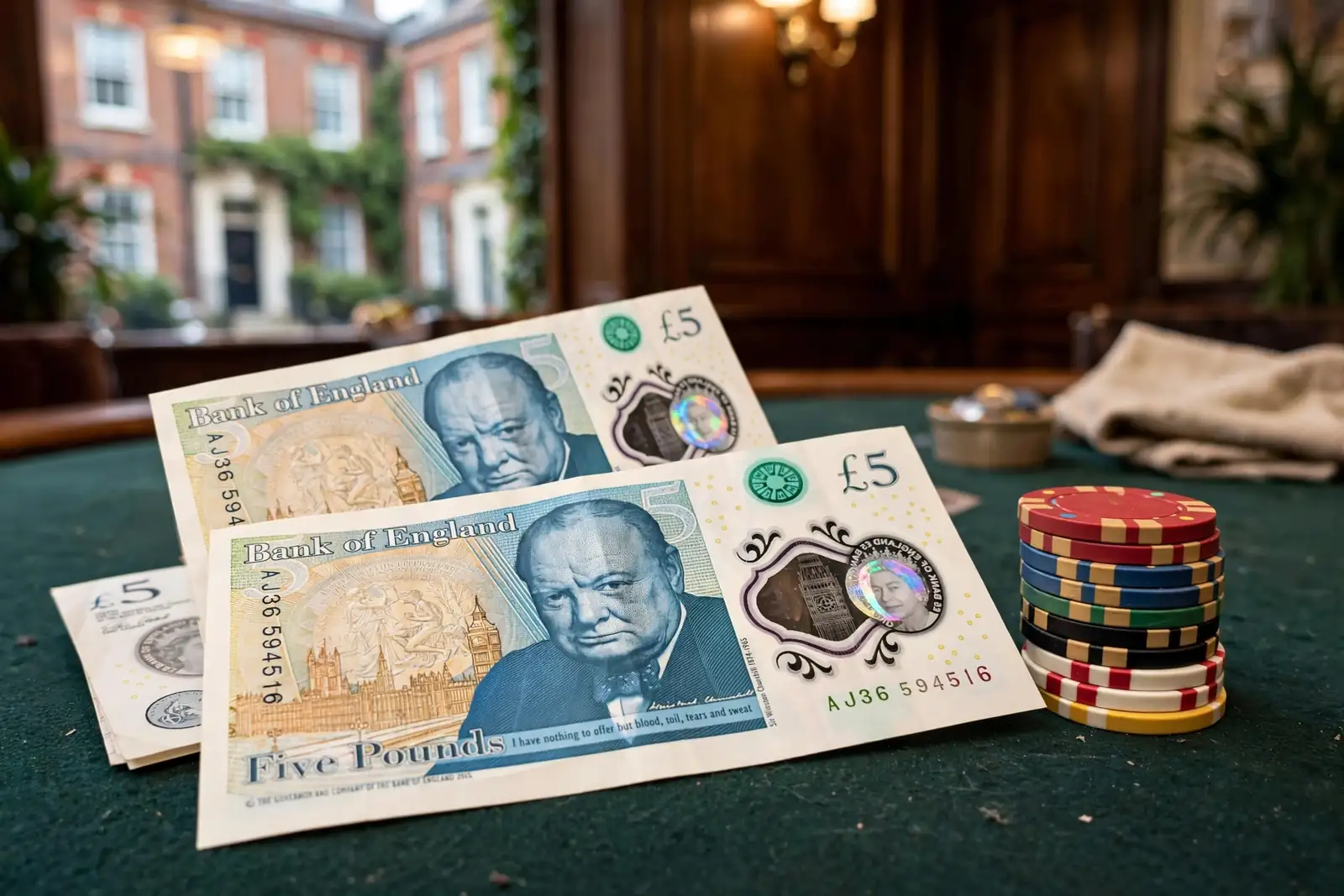
A £20 minimum is an operator-set cashier threshold, not a UK-wide rule, and it can differ from the minimum at other casinos.

How £20 Fits into the UK Casino Deposit Range
A £20 minimum deposit sits above the lower entry points available at some UK casinos. It is not a UK-wide rule or a standard set by the regulator: it is a threshold chosen by an individual operator. Other casinos may accept a smaller first deposit, so the amount you need to put in depends on the cashier minimum at the site you use.
The range starts as low as £1 at some casinos. A £5 minimum is another possible threshold, while £10 is a common reference point for casinos that accept direct banking. A specialist review of UK casinos accepting direct banking identifies £10 as the typical minimum in that category, while noting operators with thresholds of £5 or £20. These figures describe different operator policies, not a sequence of requirements that every casino follows.
That distinction matters when you compare a £20-minimum casino with a site that accepts less. The lower threshold means you can open a funded balance with less money; the higher one means the cashier will not accept a deposit below its stated amount. Neither threshold, by itself, tells you how the casino’s games work or how long a balance might last. Those are separate questions from the entry amount.
Comparing the main deposit tiers
At the £1 end of the range, the required starting amount is small, but this tier is not available everywhere. Some casinos accept deposits at that level, while others set their minimums higher. A £5 threshold is also below the direct-banking reference point reported by the specialist review. A £10 minimum is therefore a useful comparison for direct banking, but it should not be treated as a universal floor.
A £20 minimum is higher than each of those lower thresholds. If you are comparing two casinos and one accepts £5 while the other requires £20, the second asks you to commit more money before you can fund the account. That is a difference in access conditions, not proof that one casino offers better games, better terms or better value. The amount alone cannot establish those things.
£5 Minimum Deposit Casinos in the UK: What It Means
The same principle applies when comparing a £20 threshold with a £10 direct-banking minimum. The £10 figure gives context for the amount requested at some casinos that support direct banking; it does not mean every such casino uses that figure. The reported range also includes operators that set the minimum at £5 or £20. A £20 threshold is therefore within the observed range for this payment category, rather than evidence of a separate UK requirement.
Why the UK has no single £20 rule
A deposit minimum is set at operator level. The UK does not require every online casino to ask for £20, nor does it require all casinos to accept smaller deposits. That is why the available thresholds vary: one operator may accept a deposit from £1, while another may not accept an amount below £20.
This also means that the phrase “£20 minimum deposit” describes a feature of a particular casino’s cashier, not a special category of casino created by UK rules. Two sites serving the same market can set different minimums. A casino can choose a higher entry threshold even when other casinos accept less, and a lower threshold does not make that amount a market-wide standard.
For direct banking, £10 is the typical figure reported by a specialist review, but the same review notes both lower and higher operator-set amounts. Treat that as a reference point, not a guarantee about any individual cashier. If the minimum matters to your decision, the relevant figure is the one the casino displays for the payment option you intend to use.
What the comparison tells you
The deposit range helps answer one narrow question: how much the operator requires before it will accept a deposit. It does not rank casinos, establish whether an operator is suitable for you or indicate what you should spend. A £20-minimum casino simply has a higher entry threshold than a casino that accepts £1, £5 or £10.
£2 Minimum Deposit Casinos in the UK: What to Know
If you have set a maximum amount you are prepared to spend, compare that limit with the stated cashier minimum before proceeding. A threshold that exceeds your chosen limit is a reason not to deposit there. The lower minimum at another casino may fit that limit more closely, but the threshold itself should not be mistaken for a recommendation to spend the amount.
The practical comparison is therefore between operator policies: some casinos accept deposits from £1; some use £5 or £10 thresholds; and some set the minimum at £20. The £20 figure is meaningful for the individual casino displaying it, but it is not a general UK standard.
Our top casino picks for the UK
- DieselwinBonus: Welcome Pack 250% up to £4000 + 200 FS · Payout speed: 1-3 business days
- SpinFormulaBonus: 550% Up To £15,000 + 550 FS · Payout speed: 1-3 business days
- x3betBonus: Welcome Pack 100% Up to £1.000 + 200 Free Spins · Payout speed: 1-3 business days
- BeOnBetBonus: 100% up to €500 + 100 FS · Payout speed: 1-3 business days
- BritsinoBonus: Welcome Package – Get your £2,200 + 2,000 FS · Payout speed: 1-3 business days
- ChanzeBonus: Slots Welcome Bonus #1 200% up to €500 · Payout speed: 1-3 business days
- SlotoSportBonus: 500% up to £ 10 200+ 777 FS · Payout speed: 1-3 business days
- WinBeastBonus: €5000 + 500 FS + €650 Freebet · Payout speed: 1-3 business days
- Revery PlayBonus: 100% up to€1,000+ 100 FS · Payout speed: 1-3 business days
What Happens When You Deposit £20 Online
A £20 deposit begins with an account at a UK-licensed casino and a payment method the operator accepts. On a mobile casino, the steps are much the same as on a desktop: sign in, open the cashier, choose a listed payment option and enter the amount. The payment screen then passes the request to the provider for authorisation. Only after the transaction is accepted should the funds appear in the casino account.
Before you can deposit, the operator must verify your age. UK players must be at least 18, and a casino should not allow an unverified customer to fund a gambling account. If the site asks for information or documents to complete verification, follow its instructions before trying to pay. An unsuccessful or incomplete check can prevent a deposit from going through.
Set a financial limit before paying
Before your first deposit, set a financial limit using the casino’s account controls. This is a required safeguard for new customers at UK-licensed remote operators, not a payment setting applied by your bank. It is worth deciding what you can afford to spend before you reach the cashier, rather than making that decision while a deposit is being processed.
Check what the control covers and how it works in the account settings. A limit helps define the amount you are prepared to make available; it does not change the payment provider’s authorisation decision or make a deposit reversible. If the site does not present the required limit prompt before your first deposit, do not treat the payment screen as a substitute for it.
£3 Minimum Deposit Casinos in the UK: Payment Rules
Choose an eligible funding source
The payment options shown in the cashier depend on the operator. For UK gambling, deposits must be funded through permitted sources such as a debit card, a bank account or an e-wallet funded by debit. The UK ban on credit-card gambling took effect in 2020. A credit card cannot be used to fund a gambling deposit, including by routing its funds through an e-wallet or money service.
Select a method that is available to you and check that the account or card details are correct. The name and payment information may need to match the casino account details. Do not try another route to get around a declined transaction or a payment restriction: a method that disguises credit-card funding does not make that funding permissible.
Enter the amount and submit the request
Once you have chosen a method, enter £20 in the cashier and review the amount before confirming. The cashier applies the operator’s rules for that payment method. If £20 meets the displayed minimum and the provider accepts the transaction, the deposit can proceed. If it is below the minimum for that method, the cashier may reject it or require a different amount; use the conditions shown on the payment screen rather than assuming that every method follows the same threshold.
The payment provider may ask you to authenticate the transaction. Complete that step through the provider’s process, then wait for the casino to show whether the payment was accepted. Avoid submitting repeated requests while a transaction is still pending, since you may not know yet whether the first request has completed. If the payment fails, check the status in both the cashier and the payment account before attempting another deposit.
£4 Minimum Deposit Casinos in the UK: What to Check
Why the minimum can vary
At a given UK operator, the minimum deposit is generally the same across its payment methods, but this is not universal. Some casinos set a higher minimum for bank transfers than for card or e-wallet deposits. That means a £20 minimum can describe the casino’s general cashier threshold while a particular method has a different requirement.
The operator sets the threshold and presents the applicable conditions in its cashier or payment information. The payment provider also has a role in approving or declining the transaction, but its authorisation does not override the casino’s minimum. Check the selected method’s displayed terms before confirming, especially if the amount you enter is close to the stated threshold.
After an accepted deposit, check that the casino account reflects the transaction before continuing. If the payment has been debited but the balance has not updated, keep the transaction reference and contact the operator through its support channel rather than submitting the payment again immediately. This separates a processing problem from a rejected deposit and reduces the risk of making an unintended second payment.
What a £20 Minimum Means at the Cashier
A £20 minimum is an acceptance threshold for depositing money. If that is the cashier minimum shown for your account and chosen payment route, a smaller deposit will not be accepted through that route. It does not mean that you must stake £20 on a game, nor does it set the size of any individual bet.
Keep the three amounts separate: the deposit, the balance available in the account, and the stake you choose to place. A deposit adds funds to the account; a stake is the amount risked on a particular play. The cashier threshold concerns only the first of these. Once funds are in the account, the minimum deposit does not dictate how much you must stake or how many times you must play.
That distinction matters when you see “£20 minimum deposit casino” in an offer or account description. The phrase describes the lower boundary for putting money in, not a promise that the balance will last for a particular period. How far funds go depends on the stakes you choose and the results of play. The cashier figure cannot predict either.
No minimum deposit casino UK: what £1 really means
Deposits and withdrawals have separate thresholds
A casino may set a minimum amount for adding funds and a different minimum amount for requesting a withdrawal. Passing the deposit threshold does not mean you can later withdraw any amount, and the deposit minimum does not automatically become a withdrawal rule.
For instance, a specialist review has reported withdrawal minimums in the £10–£20 range at many UK casinos. Treat that as a reported range, not a rule that applies to every operator. The withdrawal conditions shown by the casino are the relevant ones for your account. They may set a threshold that differs from the amount you deposited.
This distinction can affect small balances. If the amount you want to withdraw is below the casino’s stated withdrawal minimum, you may not be able to request that amount on its own. The deposit threshold does not resolve that issue: check the withdrawal terms separately before moving money in. Also distinguish a minimum withdrawal from any maximum withdrawal condition; they describe opposite boundaries and should not be read as interchangeable.
The figures in the cashier can therefore answer different questions. “Minimum deposit” tells you what the casino will accept when you add money. “Minimum withdrawal” tells you the smallest amount the operator will process as a withdrawal request. Neither figure tells you what stake to use, and neither by itself describes how long a balance will remain available.
The cashier minimum can depend on the payment route
At a given UK casino, the stated minimum is generally the same across its payment methods. However, some operators set a higher threshold for bank transfers than for card or e-wallet deposits. So a £20 figure may apply across the cashier, or it may apply only to the route you selected.
Read the amount alongside the payment method rather than treating a single number on a general page as universal. If the cashier displays a different minimum after you choose a route, that route-specific figure is the one that governs that deposit. A payment option being listed does not, by itself, establish that every amount can be sent through it.
Online Casinos With No Sister Sites: UK Guide
This is why a £20 minimum deposit casino in the UK should be understood as an account-and-cashier condition, not as a general rule for every casino or every payment route. The exact threshold shown at the point of deposit determines whether the amount you enter can be submitted. If you change the route, check the displayed minimum again.
The same care applies when you plan to take money out. Look for the withdrawal threshold in the relevant terms rather than inferring it from the deposit screen. A £20 deposit might be accepted while a smaller withdrawal request is not, or the withdrawal threshold may be different from the deposit one. Those are separate rules applied at separate stages.
Before confirming a deposit, make sure you have identified which figure is being shown and what action it governs. If it is labelled as the deposit minimum, it is the smallest amount accepted for adding funds under the displayed conditions. It is not a required stake, a forecast of play time, or a statement of the smallest sum you can later withdraw.
How to Assess a £20-Minimum Casino
A £20 cashier minimum is useful only if it matches the amount you intend to deposit and the payment route you plan to use. Assess the operator against those practical conditions rather than treating the figure as a measure of quality. A higher threshold does not, by itself, show that a casino is better suited to you.
Start with the cashier, not a general description elsewhere on the site. Select your intended payment method and check the minimum shown before confirming a transaction. The displayed threshold is the one that matters for that payment route: a headline stating “£20 minimum” may not explain whether the same rule applies to every method. If the cashier does not make the applicable amount clear, check the operator’s payment terms before proceeding.
£1 Minimum Deposit Casinos in the UK: What to Know
Check the threshold against your payment method
At a particular UK operator, the minimum is often consistent across payment methods, but some casinos set a higher threshold for direct banking than for cards or e-wallets. That difference can affect whether a £20 deposit is possible using your preferred route. Do not assume that a figure shown beside one option applies to the others.
A specialist review of UK casinos accepting direct banking describes £10 as the typical minimum, while also noting operators with £5 or £20 thresholds. Treat that as reported market context, not as a rule for every casino or a guarantee that the current cashier will match it. The operator’s own current payment information is more relevant to your decision.
Check the payment conditions as well as the minimum. Deposits must use a permitted source: a debit card, a bank account, or an e-wallet funded by debit. Credit cards cannot be used for gambling deposits, including through a wallet or other route that passes credit-card funds into the transaction. If a payment option’s funding rules are unclear, resolve that before putting money into the account.
Decide whether the threshold fits your plans
The right question is whether you are comfortable depositing at least the amount the cashier requires, using a method you can use lawfully and reliably. If you intend to deposit less than £20, a casino with a £20 minimum will not fit that plan, even if its games or other features appeal to you. If you are content with the threshold, confirm that the selected method accepts it and that you understand any conditions attached to that method.
Before your first deposit, set a financial limit you can afford to lose. This is separate from the cashier minimum: the minimum tells you what the operator will accept, while your limit is the boundary you choose for your own spending. Check that account-level limit controls are available and set your limit before depositing.
Anjouan Casino Licence in the UK: What It Means
Compare the information, not just the headline
For a useful assessment, record the minimum shown for your chosen method, whether the terms describe a different threshold for another method, and any payment conditions that could prevent you from using it. If the information on the cashier and in the terms conflicts, ask the operator to clarify it before proceeding. A clear answer lets you judge the actual payment conditions; an attractive headline alone does not.
There is no sound basis for naming a single “best” £20-minimum casino from the cashier figure alone. That amount establishes one condition, not an overall ranking. A casino suits your needs only if its stated threshold, available compliant payment route and account controls fit the way you intend to manage your spending.
Bonus Eligibility and Wagering on a £20 Deposit
A £20 cashier minimum tells you how much you must deposit to fund the account; it does not, by itself, establish whether that deposit qualifies for a welcome offer. Promotions have separate eligibility rules, so check the offer’s terms before opting in or making a deposit.
The key distinction is between the qualifying deposit and the wagering requirement. A qualifying-deposit rule sets the amount you must deposit to activate or claim a promotion. A specialist review has reported an offer requiring a £10 qualifying deposit even where the casino accepted deposits of £5. That is an example of how promotion rules can differ from the cashier threshold, not a rule that applies to every casino. If an offer requires more than £20, a £20 deposit will not qualify; if its stated threshold is lower, other conditions may still apply.
Wagering rules work differently: they specify how much bonus value must be wagered before the bonus-related balance or winnings can be withdrawn. A deposit can meet the promotion’s qualifying threshold without completing that wagering. Read the offer terms for the wagering basis, eligible games, any withdrawal cap and the time allowed to use the bonus. Those conditions concern the promotion, not which compliant payment method you used.
The rules changed in 2026. From 19 January, UK Gambling Commission requirements limit wagering attached to bonus funds to 10 times their value. Older promotional material that quotes a higher requirement should not be treated as a current condition. The cap is a ceiling, not a promise that every offer has wagering set at that level; check the casino’s current terms and confirm that the stated requirement stays within it.
Bonus funds must also expire within the permitted period of 7 to 30 days, and wagering with bonus funds cannot involve bets above £5 per spin. These conditions affect whether you can use the promotion and meet its terms; they do not change the cashier minimum.
A promotion described as a “no-deposit bonus” should be assessed by its own rules rather than assumed to be available because you deposited £20. The label does not tell you whether a deposit is required for another part of the offer, which games count, or what conditions apply to winnings. Check the complete terms before accepting it, and do not treat an advertised bonus as cash you can withdraw immediately.
Checking a Casino’s GamStop Status
GamStop is a self-exclusion service, not a casino licence or a quality rating. To check whether an operator participates, start with GamStop’s own website and look for its information on participating businesses. Search using the casino’s full trading name, and check any other name shown in its terms or account details. A brand name and the legal company name may differ, so checking only one can leave uncertainty.
Treat the result as a status check, not proof that a casino is safe or legitimate. A casino’s absence from GamStop’s information does not establish that it is trustworthy, nor does participation guarantee that its account controls meet your needs. If you cannot confirm the operator’s identity or its status, do not infer an answer from its advertising or from a third-party list.
GamStop participation and UK licensing are separate questions. Operators offering remote gambling to customers in Great Britain must hold the relevant UK Gambling Commission licence. You can check the operator against the Commission’s public register using its legal name as well as its brand. An operator being outside GamStop does not remove the licensing requirement for serving the British market.
Non-UKGC Licensed Casinos: Rules and Risks
If you have registered with GamStop to restrict your gambling, do not use a casino that is outside the scheme as a way around that choice. The service is intended to help block access to participating operators; looking for an exception can undermine the protection you set up. Consider using account-level controls and support from an appropriate gambling-help service instead.
Before opening an account, remember that UK players must be at least 18. A licensed operator must verify your age before allowing you to deposit. You should also be able to find clear information about how to set limits and restrict access to your account. These safeguards matter whether the cashier minimum is £20 or another amount. GamStop status answers a narrow question about participation; it cannot tell you how well an operator’s other protections suit your circumstances.
Using a £20 Deposit for Real-Money Play
Once a £20 deposit has cleared and appears in your casino balance, it can fund real-money bets. The deposit is the amount added to the account; it is not the amount you must stake on each game. You can divide the balance across multiple bets, with each stake reducing it by the amount wagered. If a bet wins, the return is credited to your balance according to the game’s rules.
The balance does not translate into a fixed number of spins or a guaranteed playing time. Many slots accept stakes between £0.10 and £0.20 per spin, but the amount you choose to stake affects how quickly your funds are used. At a lower stake, the same balance can cover more spins than at a higher one, though neither stake nor balance determines whether you will win.
Keep the deposited amount separate in your thinking from any later winnings. Your account balance can change as you play, and the amount available to withdraw may therefore differ from the original £20. A deposit is not a promise that the money can be cashed out immediately in full: the casino’s withdrawal rules and any outstanding account conditions can affect what is available.
Pay particular attention to the minimum withdrawal amount. A specialist review reported minimum withdrawal thresholds between £10 and £20 at some UK casinos; that is a reported range, not a rule that applies to every operator. If your withdrawable balance falls below a casino’s threshold, you may not be able to request a payout until it reaches the stated minimum. Check the cashier’s withdrawal terms before treating a small remaining balance as cashable.
For a real-money session, decide in advance how much of the £20 you are prepared to lose, and keep that amount distinct from any balance you hope to withdraw. This makes the relationship between deposit, stakes and cash-out clearer: the deposit funds play, individual bets draw on that balance, and withdrawals depend on the balance left and the operator’s payout conditions.
When a Casino Sets Its Minimum Deposit at £20
A £20 cashier minimum is a rule set by the operator, not a standard imposed across UK casinos. It determines the smallest amount the cashier will accept under the conditions shown for that account. The operator may apply the threshold to every payment option, or define separate minimums for different methods.
At a given casino, the minimum is generally the same across payment methods. However, some operators set a higher threshold for direct banking than for card or e-wallet payments. That means a casino described as having a £20 minimum may not necessarily require £20 through every route: the cashier’s method-specific terms determine what applies when you deposit.
The distinction matters because a headline figure can hide how the cashier is configured. If the operator sets a £20 minimum for all methods, changing from a card to direct banking will not reduce the required amount. If the thresholds differ, the amount displayed beside the selected method is the relevant one. Check the terms for each option rather than assuming that one stated minimum covers them all.
A difference between payment methods does not mean the casino has changed its overall policy or that every customer sees the same set of options. It reflects how the operator has configured its cashier. The method available to you and its stated threshold together determine whether a particular deposit can be submitted.
Treat the £20 figure as an operator-level condition, then check whether it applies to the payment route you intend to use. This avoids mistaking a general description for a promise that every method has the same minimum. The cashier’s displayed terms are the practical reference for that transaction.
PayPal and Other E-Wallet Deposits
A £20 cashier minimum does not tell you whether PayPal or another e-wallet is available. Payment options are set by each casino, so check the cashier and the payment terms before choosing a method. An operator may accept a £20 deposit by one route but not offer the wallet you prefer.
The important distinction is how the wallet is funded. UK rules prohibit credit-card gambling deposits, including payments routed through a money service. An e-wallet used to fund gambling must therefore draw on debit-card or other permitted non-credit funds; credit-card money must not be routed through the wallet to reach the casino. The restriction concerns the source of the funds, not merely the name shown at the cashier.
The UK Gambling Commission’s credit-card gambling ban took effect in 2020. For an e-wallet payment, check that the wallet balance comes from a debit card or another permitted source, and that the wallet does not allow credit-card funds to be used for gambling. If you cannot establish that the money is debit-funded, do not use it for a casino deposit.
Before confirming payment, compare the casino’s displayed minimum with the amount you intend to send and check whether the selected wallet is actually listed. A £20 minimum does not mean every e-wallet will accept that amount, nor does it imply that PayPal is supported. Use only a route that satisfies the funding restriction; selecting an e-wallet does not make a credit-funded payment compliant.
How to Check Whether a £20-Minimum Casino Is Legitimate
A £20 cashier minimum says only how much the operator will accept as a deposit. It does not establish that the casino is authorised to serve players in the UK. Before opening an account, check the operator against the UK Gambling Commission’s public register and confirm that its operating licence is current and covers the gambling service being offered. A site’s own statement that it is licensed is not a substitute for checking the register.
Age is another basic compliance check. UK players must be at least 18, and an operator must verify your age before allowing you to deposit. If a site lets you fund an account before completing that check, do not treat the low-friction registration process as evidence of legitimacy.
Check how the cashier handles funding as well. Since the UK’s credit-card gambling ban took effect in 2020, a gambling deposit must not be funded by credit. Permitted routes include a debit card, a bank account, or an e-wallet funded by debit. A wallet must not be used to channel credit-card funds into gambling. If the payment screen offers a credit card for a casino deposit, or the funding route is unclear, stop rather than assume it is acceptable.
You can also look for the operator’s complaints process and information about access to an approved Alternative Dispute Resolution service. These are compliance safeguards, not proof that every aspect of the site will suit you. Keep the checks separate: confirm the UK Gambling Commission licence, age verification, and lawful funding before sending money. A £20 minimum alone cannot answer any of those questions.
Casino Sites and Safety: UK Options Explained
Can players claim a bonus with a small deposit?
Yes, if your deposit meets the offer’s qualifying minimum. Welcome offers commonly require £5 to £10, so a £1 deposit usually will not activate one.
What is the lowest deposit available at UKGC-licensed casinos?
The lowest tier is £1, though it is rare and may be limited to particular payment methods.
Which payment method is best for low-deposit casino players?
Debit cards are a widely available choice for low deposits, and some e-wallets also support £1 transactions. Check the cashier’s minimum for your chosen method before paying.
Can I take out winnings from a £1 deposit?
Yes, if your winnings meet the casino’s minimum withdrawal amount and you satisfy its requirements. Some casinos set withdrawal minimums at £1 to £5, while many use £10 to £20.