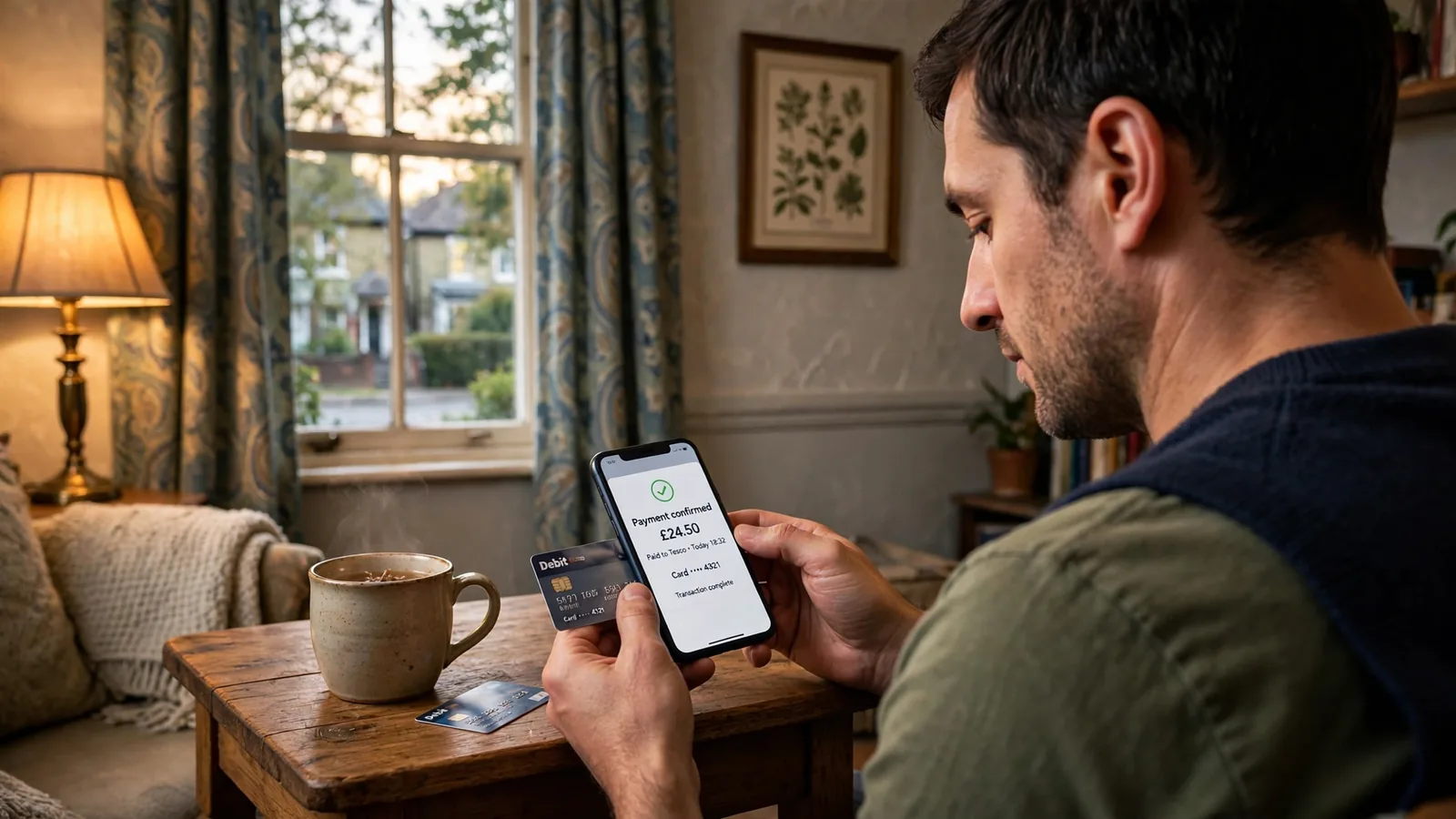
Phone-credit payments are charged through a mobile account, while the casino balance shows the funds available for play.

How a phone-credit deposit reaches your casino account
A Pay by Phone deposit links two separate accounts: your mobile casino balance and your account with your mobile network. The casino balance is where funds become available for play. The network account is where the cost of the payment is recorded. The charge does not simply disappear because you used a phone; it is collected through the billing arrangement attached to your mobile service.
The way that charge appears depends on whether you use a monthly contract or pay as you go. With a contract, the deposit charge is added to your next mobile phone bill. It becomes part of the amount you owe the network, alongside the other charges on that bill. With pay as you go, the cost is deducted from your available phone credit. In either case, the mobile network is the route through which the payment is charged to you.
That distinction matters when you check what happened to your money. Your casino account and your mobile account show different sides of the same payment. The casino balance reflects the funds credited for gambling; the phone bill or prepaid balance reflects the amount charged through your network. If you are trying to understand the total cost, check the relevant mobile account as well as the casino’s transaction record. The two records answer different questions: one concerns the casino balance, the other the network charge.
A network charge may also include a separate premium-rate fee. A specialist review reports fees in the range of £0.50 to £1.50 for some Pay by Phone transactions. This is not a charge that applies to every network or every payment. Whether it appears depends on the terms of the mobile service and the transaction. Treat the amount shown by your network as the relevant figure for your own account, rather than assuming that the casino balance tells you the full cost.
Offshore Casino Sites for UK Players: Licences and Risks
The distinction between the deposit and any network fee is useful. The deposit is the amount directed to the casino account; a premium-rate fee, where applied, is an additional cost associated with processing the phone payment. It may therefore be possible for the amount charged through your mobile account to differ from the amount credited to your casino balance. Reviewing the network bill or prepaid balance helps you identify whether an extra fee has been added.
Pay by Phone can feel like a single payment because it is made through a mobile service, but it involves separate records and parties. The casino records the funding of your gambling account. Your mobile network records the charge against your contract bill or pay-as-you-go credit. Keeping those roles separate makes the transaction easier to read: a change in casino balance is not itself a mobile bill entry, and a mobile bill entry is not the casino’s account history.
This also explains why the payment can be relevant even when you are not paying with a bank card. The source of the charge is your mobile service account, rather than a card account. For contract customers, the amount is collected as part of the next bill. For pay-as-you-go customers, the available phone credit is reduced. The basic billing result is the same in both cases: the cost is assigned to the mobile account associated with the phone service.
When checking a Pay by Phone entry, compare the casino’s record with the mobile account record and look for whether the charge is listed as part of the bill or deducted from prepaid credit. If the mobile account shows an additional premium-rate fee, distinguish it from the amount credited at the casino. This avoids treating every difference between the two records as a missing casino deposit.
The central point is that mobile phone credit is a billing route, not a separate form of casino balance. The casino account receives the deposit, while your network collects its cost through your next bill or by reducing your pay-as-you-go credit. Any premium-rate fee is a separate possible part of the network-side charge, so the mobile account is where you can confirm what you were billed.
Your casino balance and your mobile account show different sides of the same payment. The casino balance reflects the funds credited for gambling, while the phone bill or prepaid balance reflects the amount charged through your network.
Our top casino picks for the UK
- DieselwinBonus: Welcome Pack 250% up to £4000 + 200 FS · Payout speed: 1-3 business days
- SpinFormulaBonus: 550% Up To £15,000 + 550 FS · Payout speed: 1-3 business days
- x3betBonus: Welcome Pack 100% Up to £1.000 + 200 Free Spins · Payout speed: 1-3 business days
- BeOnBetBonus: 100% up to €500 + 100 FS · Payout speed: 1-3 business days
- BritsinoBonus: Welcome Package – Get your £2,200 + 2,000 FS · Payout speed: 1-3 business days
- ChanzeBonus: Slots Welcome Bonus #1 200% up to €500 · Payout speed: 1-3 business days
- SlotoSportBonus: 500% up to £ 10 200+ 777 FS · Payout speed: 1-3 business days
- WinBeastBonus: €5000 + 500 FS + €650 Freebet · Payout speed: 1-3 business days
- Revery PlayBonus: 100% up to€1,000+ 100 FS · Payout speed: 1-3 business days
Amounts and limits when you deposit by phone
When you use Pay by Phone at a mobile casino, the amount you enter and the operator’s per-transaction cap are related but not identical. The amount you enter is the value of that particular deposit. The cap is the largest amount the operator will accept in one transaction through this payment route. If the cap is lower than the amount you want to fund, you cannot submit that larger deposit as a single Pay by Phone transaction.
A specialist review of Pay by Phone casinos describes deposits in the £5 to £30 range, with a £30 cap per transaction reported for most operators. Treat those figures as a guide to the range described by that review, not as a promise that every casino accepts every amount in it. The available choices depend on the operator’s payment settings, and the amount shown to you at the time of payment is the relevant one for that transaction.
This distinction matters when comparing the amount you planned to deposit with the amount the payment screen permits. A figure within the reported range may still be unavailable at a particular casino: the operator could set a different cap or offer a narrower selection of amounts. Equally, a stated cap is a ceiling, not a minimum deposit or a recommendation to deposit that much. Check the values displayed in the cashier before deciding what to enter.
Reading the cap correctly
A per-transaction cap applies to one payment attempt. It does not, by itself, describe how much you may deposit across a day, week or month. Those are separate account-level controls, so a transaction cap should not be read as a total allowance for a period. Nor does the reported £30 figure establish that you can make repeated payments of that amount; the cap alone says nothing about any other restrictions the operator may apply.
Foreign Casinos for UK Players: Key Facts
The practical question is therefore not simply whether a casino advertises Pay by Phone, but what amount its payment screen currently allows you to select. A payment option can be available while still being unsuitable for the sum you have in mind. If the amount you want to deposit is above the displayed per-transaction maximum, do not assume that the casino will accept it by splitting it into further payments. The cap describes the maximum for each transaction, but it does not confirm that repeated transactions will be allowed.
If the payment screen offers a selection of amounts, choose from those options rather than assuming that any figure within the review’s stated range will work. If it provides an amount field, check that your entry is within the displayed minimum and maximum before proceeding. The screen’s instructions take precedence over a general guide because the operator controls the values available for its own cashier.
Planning around a single payment
It can help to decide on the intended deposit amount before opening the payment screen. Then compare it with the displayed range and cap. If the amount fits, you can assess that single transaction on its own. If it does not, pause and check the operator’s payment information rather than treating the cap as a technical obstacle to work around. The fact that an amount is below a reported maximum does not mean the operator has to accept it; the available options still determine what can be submitted.
DO
- Check the cashier to see the specific amounts the operator allows.
- Verify the maximum per-transaction cap on the payment screen.
DON’T
- Assume a stated cap is a minimum deposit amount.
- Assume you can bypass a transaction cap by splitting it into multiple payments.
For a mobile casino that accepts payment with phone credit, the key figures to verify are thus the amount the cashier lets you enter and the maximum it permits for one transaction. A guide can help you recognise the broad range described for this method, but it cannot replace the casino’s current payment terms. Those terms may differ between operators, and the payment screen is where the permitted amount for your intended deposit becomes clear.
Keep the comparison narrow: the amount you enter is the value of one deposit, while the per-transaction cap is the upper boundary for that payment. Neither figure tells you what your overall account deposit limits are, and the cap should not be mistaken for a target. Once you know the amount the operator accepts in a single Pay by Phone transaction, you can decide whether that route matches the sum you intended to deposit.
What the casino’s mobile interface changes
A mobile casino can run in your phone’s browser without requiring a separate app. Most casinos with a UK Gambling Commission licence offer instant play through mobile browsers, so you can open the site, sign in and use its games within the browser window. “Instant play” describes access: it does not mean every page or game loads instantly, because performance also depends on the connection, the device and the way the casino has built its interface.
The distinction matters when you are using a small touchscreen. A desktop page may squeeze menus, account controls and game content into a narrow display. A mobile-oriented layout instead rearranges these elements so they remain readable and can be reached by touch. You can assess the design by checking whether the main navigation is visible, text is legible without zooming, and controls have enough space around them to avoid accidental taps. These details affect how easily you move between the account area and a game; they do not change the underlying payment method.
Online Casinos With No Sister Sites: UK Guide
Browser access and app-style delivery
There are two different things that may look like an app. A native app is built for a phone’s operating system. A native wrapper is an app-like shell around content that may still be delivered from the casino’s web platform. A WebView embed displays web content inside an app container. The interface may look similar in each case, but the route by which it receives and responds to your input can differ.
A specialist review reported that, in its comparison, a spin control in a native wrapper responded at the moment of touch, while a WebView embed had a noticeable delay of half a second. Treat that as an observation about the tested interfaces, not a fixed property of every casino app or every phone. A slow response can also arise from the connection or from the game taking time to process an action. If a button seems unresponsive, tapping repeatedly may send more than one input once the interface catches up. Waiting for visible feedback is safer than assuming the first tap failed.
The same principle applies to account forms. A well-adapted page makes it clear which field is active, preserves typed information when you move between fields, and shows whether an action has been accepted or needs attention. If the screen provides no clear response after you tap a control, avoid repeating the action until you can tell what state the page is in. That reduces confusion when navigating an account on a small screen.
Mobile Interface Delivery
A native app is built for a phone’s operating system, whereas a native wrapper is an app-like shell around content. A WebView embed displays web content inside an app container.
What changes during a deposit
The mobile interface changes how you reach and use the deposit area, not what a payment service does behind the scenes. On a phone, the deposit page may be presented as a full-screen panel, a separate page or a form within the account menu. The important usability question is whether you can identify the available controls and review what you have entered before confirming. A clear layout helps you distinguish between selecting an option, entering information and submitting the form.
This is relevant when looking for mobile casinos that accept phone-credit payments: the method’s availability is separate from whether the site is comfortable to use on a phone. A payment option may appear in an account page, but an awkward menu can make it hard to find or understand. The interface should make the selected option and the next action visible. It should not require you to infer whether a tap has registered from a screen that has not changed.
Mobile browsers also keep the casino within a familiar browser environment, while an app-style wrapper can make navigation feel more contained. Neither format alone establishes that the operator accepts a particular payment method, and neither guarantees a smoother experience. Check how the actual site behaves on your device rather than treating the words “app” or “mobile” as evidence of usability.
For play, screen layout and input response shape the experience once a game opens. A game designed for a phone can place its controls where your fingers can reach them and fit the display without forcing constant zooming. A page that merely scales down a desktop layout may leave controls cramped or text difficult to read. The game still depends on the same basic interface signals: a visible response to a tap, a clear loading state, and a screen that lets you tell whether the requested action has occurred.
Offshore Casinos for UK Players: Legal and Payment Checks
When comparing mobile casinos that pay with phone credit, separate three questions: whether the casino works in your browser, whether its interface is clear on your device, and whether the payment option is available in your account. The first two concern mobile delivery. The third concerns the operator’s payment arrangements. Keeping those questions distinct helps you judge the actual phone experience without mistaking a polished screen for proof of a particular payment feature.
Minimum deposits and account-level limits
The minimum accepted deposit and the limit on deposits over time are separate controls. A minimum is the smallest amount the casino will accept for a single funding transaction. An account-level deposit limit restricts how much you can add over a chosen period. It can apply regardless of whether you use Pay by Phone or another available payment method.
A specialist review reported that many casino apps set their minimum deposit at £5, while some accept £2. Treat those amounts as a guide to the operators covered by that review, not as a fixed rule for every mobile casino. The minimum is set by the individual operator and may differ between casinos, so check the amount shown in the cashier before deciding how much to add. A low minimum does not mean you have to deposit that amount repeatedly: your account limit may be lower than the total you could otherwise deposit.
Attention An account-level deposit limit is a cumulative control that can block a deposit even if it meets the casino’s minimum and the payment method is valid.
Account-level limits serve a different purpose. UKGC-licensed operators must make deposit limits available, with settings for daily, weekly or monthly periods. New customers must also be prompted to set a financial limit before making a first deposit. You can find the controls in your account settings; the exact menu label and layout depend on the casino.
The period attached to a limit determines how it constrains deposits. A daily setting governs deposits within a day, while weekly and monthly settings apply across their respective periods. These are cumulative account controls, not a per-transaction ceiling. If you reach a limit, a further deposit may be blocked even when it is above the casino’s minimum and the payment method would otherwise be accepted. Conversely, a transaction below your account limit can still fail if it does not meet the casino’s minimum.
When setting a limit, consider the total amount you intend to deposit across all payment methods, rather than treating each method as a separate budget. That makes the control useful even if you change how you fund the account. The setting is not a prediction of how much you will spend; it is a boundary on deposits. Check which period the control covers and what the account screen says about changing it before relying on it.
Do not confuse an account-level limit with the amount a phone-credit payment provider or casino allows in one transaction. The former is a broader control on your account over time; the latter concerns an individual payment. Both can affect whether a deposit is accepted, but they answer different questions. If a deposit is rejected, check the minimum and your remaining account allowance separately rather than assuming one explains the other.
Casino sites not registered with GamStop in the UK
The cashier and account settings are the practical places to confirm the operator’s current terms. A displayed minimum tells you the smallest transaction the casino will accept; the limit controls show how much you can deposit during the selected period. If you use a mobile casino, you can still manage these settings through your account, although the route to them may differ between its app and mobile website.
Casino not on Gamstop is an affiliate. If you click a link and deposit, the site may receive payment.
Comparing phone credit with other mobile deposit routes
A mobile casino using phone credit is not the only way to fund an account from a handset. Apple Pay and debit cards can also be used where the operator offers them, but each route handles authorisation differently. The useful comparison is not simply whether you can tap a phone: it is how the payment is approved and whether your bank or mobile provider affects the transaction.
A specialist review reported that Apple Pay deposits completed instantly in the tested casino apps, with approval taking two taps. That makes it a direct option when you want to confirm a payment through the wallet already set up on your device. The observation relates to those tested apps; the payment option still has to be available at the casino you use, and your Apple Pay setup must be ready.
Debit-card deposits are also described as generally instant in a specialist review, but some banks flag casino payments. If a bank declines or holds a transaction, the casino cannot treat the card route as completed just because you entered the details on a mobile screen. A card may therefore be a straightforward alternative when your bank permits the payment, but the bank’s response remains part of the process.
Apple Pay
Can be used where the operator offers it and typically involves approval through a device wallet.
Debit Cards
Generally instant, but some banks may flag or decline casino-related transactions.
Pay by Phone
Funds the account via your mobile service, charging your contract bill or reducing prepaid credit.
Pay by Phone works differently from both. Instead of authorising through a wallet or card, you use the phone-credit route offered by the casino and the charge is handled through your mobile account. That can suit you if you want to avoid entering card details, but it does not make the payment equivalent to Apple Pay: the funding source and the party processing the charge differ.
For mobile slots, all three routes can fund the same casino balance when supported by the operator. The choice is about the payment channel, not a separate kind of slot account. If immediate confirmation is the priority, the reported Apple Pay result and the general debit-card experience give you a basis for comparison, while remembering that a bank can intervene in a card payment. If you prefer to pay using phone credit, check that the casino offers Pay by Phone and that your mobile account can be charged.
Before selecting a route, check the payment methods shown in the casino cashier on your device. Availability can differ between operators, and a method displayed by one mobile casino may not appear at another. Use the route whose approval process and funding source suit you; a mobile-friendly interface alone does not determine how a payment is authorised.
Playing mobile slots after funding your account
After your balance is available, you can open a slot from the casino’s mobile site and play in the browser. Most UKGC-licensed casinos offer instant play through mobile browsers, so you do not necessarily need to install an app before accessing the games. The browser is the point of entry: sign in, select a slot from the casino’s games area and wait for it to load.
International casinos for UK players: licensing and terms
A phone-credit payment method does not determine which slots you can play. It funds the casino account; game access depends on the games the operator makes available to your account and whether the title runs on your device. If a slot is missing from the catalogue or does not load, changing how you funded the account will not resolve that issue.
On a phone, the game interface is arranged for a smaller screen. Controls and information may be grouped differently from a desktop version, so check the displayed stake and game rules before starting. The game’s own controls govern play once it has loaded; the method used to fund the balance does not change those controls.
Mobile-browser access also means you can return to the casino without treating the slot itself as a separate app. A browser session may end if you close the tab or are signed out, so save no assumption that the game will resume at precisely the same point. Check the game screen after returning before continuing.
If you are choosing a casino for phone-credit slots in the UK, distinguish the payment option from the actual playing experience. Confirm that the games you want appear in its mobile catalogue and that they open in your browser. A casino’s page may be accessible on a phone while an individual game is unavailable or incompatible with the device; access to the site alone does not establish that every title will run.
Playing Mobile Slots
- Check if the casino works in your mobile browser.
- Confirm the interface is clear and readable on your device.
- Verify the chosen payment option is available in your account.
- Ensure the specific slot game is compatible with your device.
The key practical sequence is simple: reach the casino in your mobile browser, open a listed slot, and use the game’s on-screen information to understand its controls. Pay by Phone describes a way to fund the account, not a special category of slot or a different way to play.
Phone-credit deposits and what happens at withdrawal
A Pay by Phone deposit and a withdrawal are different parts of the account’s payment flow. Phone credit can fund your casino balance, but that does not make your mobile airtime balance a cash-out route. Any winnings remain in the casino account until you request a withdrawal through a method the operator supports.
The method used to deposit is almost always the one the casino requires for withdrawal. This is a general payment rule, not a promise that every deposit method can receive money back. If you funded your account with phone credit, check the operator’s withdrawal information before you deposit: it should explain which payment methods are available for paying out and what to do when the deposit method cannot receive withdrawals.
That distinction matters because a phone-credit payment is tied to your mobile account, while a withdrawal needs a supported destination for funds. Do not assume that the casino can convert a deposit made through your phone bill or pay-as-you-go balance into cash on that same account. If the cashier lists a different withdrawal route, follow the operator’s instructions and confirm that you can use the listed method.
UK online casino RTP: understanding payout claims
If you have deposited using more than one method, the casino may still require the original method for a withdrawal. Since the deposit method is almost always linked to the required withdrawal method, adding another payment option does not necessarily change how the casino will process a payout. Check the account’s payment terms rather than relying on the method you would prefer to use.
Before requesting a withdrawal, review the cashier’s available options and any account-specific instructions. If the phone-credit method is not listed for withdrawals, use the route the operator specifies; do not treat the original phone payment as a withdrawable balance. This keeps the distinction clear: phone credit is a way to fund casino play, while a cash withdrawal is handled through a payment method the operator accepts for payouts.
Checking that a phone-credit casino is UK-licensed
A Pay by Phone option does not, by itself, show that a mobile casino is authorised to serve players in the UK. Check the operator’s UK licence separately before creating an account or depositing. The licence belongs to the company operating the casino, so confirm that the name on the site matches the licensed business rather than relying on a familiar brand or payment logo.
The operator’s UK Gambling Commission licence number should appear at the bottom of its homepage. Use that number to look up the operator in the UKGC register and check that the licence is current and covers remote gambling. If the number is absent, does not match the business, or cannot be verified, do not treat the site as a licensed UK casino.
UK Licensing
- Always verify the operator’s UKGC licence number on their homepage.
- Check the UKGC register to ensure the licence is current and covers remote gambling.
- A Pay by Phone option does not guarantee that a site is UK-licensed.
This matters because operators offering real-money gambling to customers in Great Britain must hold the relevant UKGC licence. A UK Gambling Commission licence is the strongest consumer protection available in the market: it places the operator within the UK regulatory system. UK-licensed operators must also belong to an approved alternative dispute resolution provider. If a legitimate complaint is not resolved through the operator’s own process, you can take it to that provider.
A licence does not confirm that a particular payment option will work for your account, nor does a Pay by Phone listing establish that the operator is licensed. Treat these as separate checks: verify the licence in the UKGC register, then read the casino’s own payment information for its available methods. This helps you distinguish a licensed mobile casino that offers phone-credit funding from a site that merely displays a payment claim.
Phone-credit funding and no-deposit bonus terms
A bonus linked to a Pay by Phone deposit is a deposit offer: you must make a qualifying deposit before the offer applies. A genuine no-deposit bonus does not require that funding step. The two offers therefore work differently, even if both can be used to play online slots on a mobile device. Check the promotion’s eligibility wording rather than assuming that choosing phone credit makes an offer “no deposit”.
The terms determine whether bonus funds can become withdrawable winnings. A specialist review describes wagering requirements of 35x to 40x the bonus amount in the offers it assessed. That is a substantial amount of play, so check whether the requirement applies to the bonus alone or to the bonus plus your deposit. The offer’s own terms should specify the calculation.
The same review reported maximum winnings of £100 to £200 on many bonuses it examined. Treat that as a reported range, not a universal cap: the operator’s terms set the limit for the offer you accept. A cap can restrict what you may withdraw even if your balance is higher.
Casino Sites and Safety: UK Options Explained
Time limits also affect the practical value. The review reported periods of 7 to 14 days for meeting wagering requirements, while some offers allowed only 72 hours. Check when the clock starts and what happens to unused bonus funds when it expires. A short deadline can make an offer difficult to complete, particularly if eligible games contribute differently or are excluded.
Before opting in, read the complete terms for the qualifying deposit, wagering calculation, eligible games, deadline and cashout cap. If any condition is unclear, do not assume the bonus is withdrawable on the same basis as your deposited funds.
Bonus conditions and protection when you deposit by phone
Using Pay by Phone to fund a mobile casino account does not remove the conditions attached to a bonus. Before accepting an offer, check whether your deposit method qualifies and read the rules for turning bonus funds or related winnings into withdrawable money.
Non-GamStop European Casinos: UK Rules Explained
A specialist review of bonus terms identifies four conditions that can affect a bonus withdrawal: wagering requirements, maximum-bet rules, game weighting and maximum cashout caps. They work differently. Wagering requirements set how much qualifying play is needed; a maximum bet can make play in breach of the offer rules; game weighting determines how much each eligible game contributes; and a cashout cap limits the amount payable under the offer. A bonus may therefore look generous while its conditions reduce what you can ultimately withdraw. Check the full terms before opting in, and keep your play within any stated restrictions.
Set a deposit limit as a separate safeguard. It controls how much you can put into your account over a chosen period; it does not change a bonus’s wagering or withdrawal conditions. UK-licensed operators must provide these controls in account settings, with daily, weekly and monthly options. New customers must also be prompted to set a financial limit before making their first deposit. Choose a limit that reflects what you can afford to lose, rather than raising it to meet an offer’s conditions.
If the bonus rules are unclear, do not assume that a phone-credit deposit makes an exception. Check the operator’s terms or ask customer support to clarify how the offer applies before you accept it.
How long should a mobile casino withdrawal take in 2026?
For UK-licensed casinos, e-wallet withdrawals are realistically expected to take under 24 hours; the fastest observed PayPal payout took 2 hours. Bank transfers typically take 3–5 business days, while debit card withdrawals take 1–3 business days.
Can I set deposit limits on mobile?
Yes, UKGC-licensed casinos must let you set deposit limits in your account settings. You can choose daily, weekly or monthly limits.
Are there any fees for using phone credit?
Some mobile networks add a premium-rate fee, usually £0.50 to £1.50. Check your mobile bill or pay-as-you-go balance to see whether one was charged.
How fast are withdrawals on these apps?
For UK-licensed operators, e-wallet withdrawals are generally expected within 24 hours; the fastest observed PayPal payout took 2 hours. Bank transfers usually take 3–5 business days, and debit card withdrawals 1–3 business days.
What does wagering on a welcome offer actually mean?
It means you must place bets totalling a set multiple of the bonus before withdrawing bonus-related winnings. Requirements are commonly 35x to 40x the bonus, and maximum bet rules, game weighting and cashout caps can also affect what you can withdraw.