The guide explains the live presentation and interface, plus how to assess casino access, demos and results without overreading statistics.
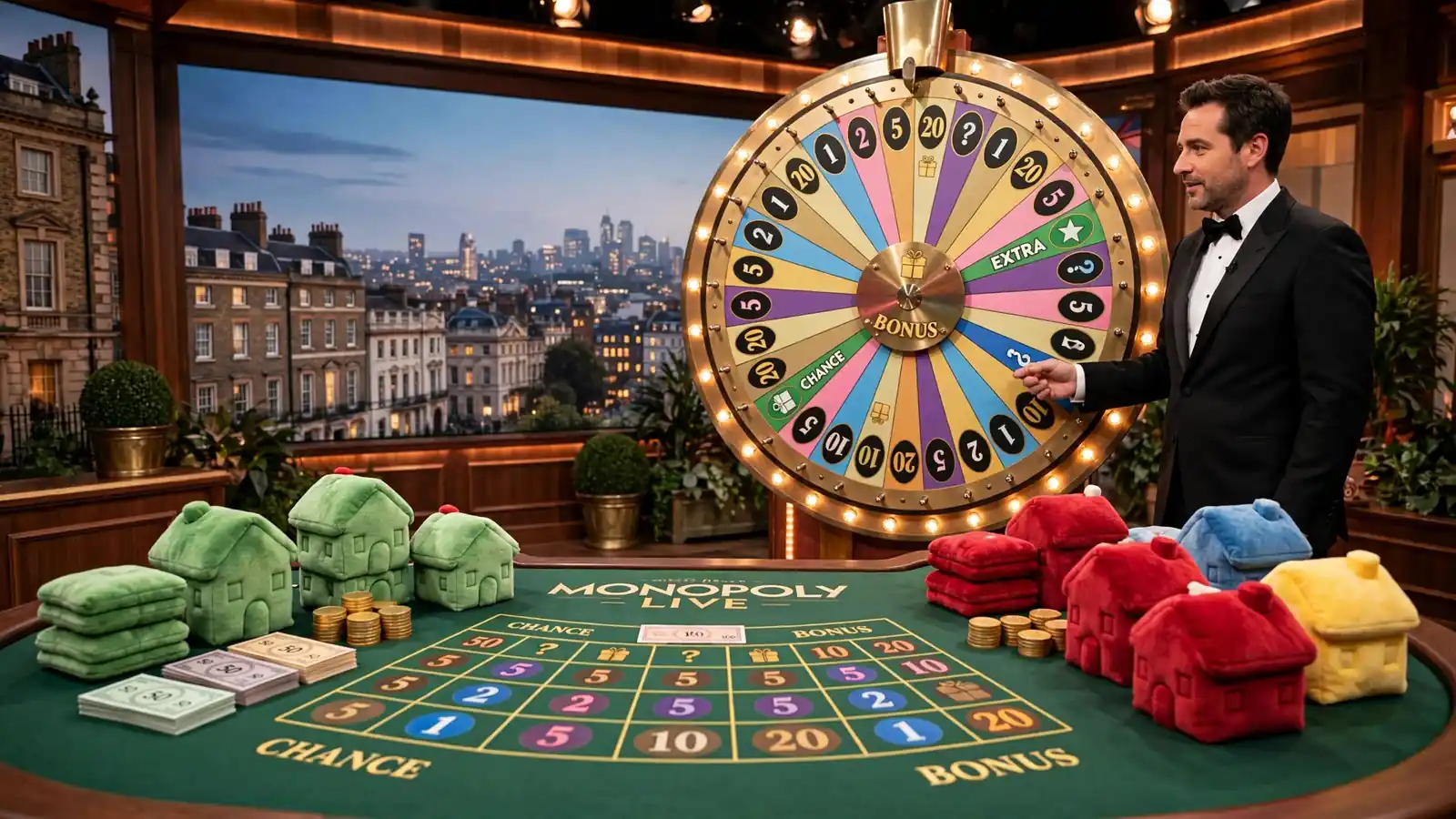
How Monopoly Live fits into a live casino
A live casino combines a casino game interface with a real-time video feed. Instead of seeing only a software-generated table or game screen, you watch a live presentation while using controls on the casino site to take part. The interface connects your selections to the game and displays relevant information alongside the video. This arrangement is different from a conventional digital casino game, where the action is represented entirely through software graphics.
The word “live” describes how the game is presented, not a guarantee that every part of the experience is handled in the same way. A live-casino product may use a presenter, a physical setting and camera equipment, while software manages the player interface and the exchange of information. The exact arrangement depends on the product. It is therefore useful to treat the video and the game interface as connected parts: one shows the presentation, while the other lets you interact with it.
Live casinos cover more than one type of game. Their catalogues can include familiar table games, such as blackjack and roulette, as well as formats presented in a more entertainment-led style. A streamed game may share the live-casino setting with a traditional table game without having the same pace, layout or way of presenting the action. The category describes the delivery format; it does not, by itself, tell you how a particular game works.
Online Bingo UK: Formats, Tickets and Slots
Grosvenor provides a concrete UK-market reference point for how this format developed. In 2013, the operator introduced live casino games, including Blackjack, Texas Hold’em and Roulette. That range shows how a live-casino catalogue can bring established casino games into a streamed setting. It also helps explain why the term “live casino” is broader than a single kind of table: products can differ in their presentation while being grouped under the same general format.
Monopoly Live belongs in this wider category as a title associated with live casino. Its name identifies the game a player is looking for, but the name alone does not explain its rules, controls or sequence. Nor does the word “Monopoly” establish that the live product works like the board game. To understand the experience, you need information specific to the product rather than assumptions drawn from its title or from other live games.
That distinction matters when you encounter phrases such as “live Monopoly casino” or “casino Monopoly live”. They point towards a live-casino version of a named game, but they are not technical descriptions of how it operates. A useful first question is whether the product is presented as a live experience, a standard digital game, or both in different versions. The label helps you locate the broad category; the game information explains the actual format.
You can also separate three things that are easy to conflate. The first is the live-casino format: a streamed presentation paired with an interactive interface. The second is the individual game, with its own rules and instructions. The third is the casino site through which a player may be able to access it. Knowing that a title is associated with live casino does not establish which sites currently offer it, and a site’s catalogue does not define the game’s rules. Each question needs its own evidence.
Live Casino UK: How Online Tables Work
This is why Monopoly Live should be understood as one product within a larger live-casino environment, rather than as a synonym for live casino as a whole. The category includes different presentations and game types; the title identifies one particular experience within it. If you are unfamiliar with the format, start by distinguishing what the video shows from what the on-screen controls do, then use the game’s own instructions to understand its operation. That approach avoids treating a familiar name or visual style as a substitute for the rules.
The live presentation can make the experience feel closer to watching a hosted event than using a wholly digital table, but presentation and game mechanics remain separate. A host, camera view or animated element—where a product uses them—does not, on its own, tell you what determines an outcome. The game’s stated rules are the relevant explanation. Keep that separation in mind when comparing the broad idea of a live casino with the specific title you have opened.
Financial Risk
The format does not change the basic financial risk of gambling. Decide what you can afford to lose before you play.
Whether you are considering Monopoly Live or another live-casino product, the format does not change the basic financial risk of gambling. Decide what you can afford to lose before you play, and do not treat the live presentation as evidence that an outcome can be anticipated.
Our top casino picks for the UK
- DieselwinBonus: Welcome Pack 250% up to £4000 + 200 FS · Payout speed: 1-3 business days
- SpinFormulaBonus: 550% Up To £15,000 + 550 FS · Payout speed: 1-3 business days
- x3betBonus: Welcome Pack 100% Up to £1.000 + 200 Free Spins · Payout speed: 1-3 business days
- BeOnBetBonus: 100% up to €500 + 100 FS · Payout speed: 1-3 business days
- BritsinoBonus: Welcome Package – Get your £2,200 + 2,000 FS · Payout speed: 1-3 business days
- ChanzeBonus: Slots Welcome Bonus #1 200% up to €500 · Payout speed: 1-3 business days
- SlotoSportBonus: 500% up to £ 10 200+ 777 FS · Payout speed: 1-3 business days
- WinBeastBonus: €5000 + 500 FS + €650 Freebet · Payout speed: 1-3 business days
- Revery PlayBonus: 100% up to€1,000+ 100 FS · Payout speed: 1-3 business days
What to check before choosing a casino that offers Monopoly Live
A casino listing Monopoly Live is not automatically suitable for you. Before you create an account or deposit, check who operates the site, whether that business is authorised to serve customers in Great Britain, and what protections apply to your account. These checks are more useful than an unsupported “best casinos” ranking: a recommendation cannot replace confirming the operator’s current status.
Confirm the operator’s licence
The UK Gambling Commission regulates online gambling, and remote operators serving customers in Great Britain must hold the relevant Commission licence. This requirement applies even when an operator’s equipment is located elsewhere. The Commission is the sole regulator for commercial gambling in Great Britain.
Start with the casino’s terms and conditions or footer to identify the legal name of the operating business and its licence number. Then search for that business on the Commission’s public register. Check that the register entry corresponds to the company named by the casino, and verify that the authorisation covers the relevant remote gambling activity. A logo or a statement on the casino’s own website is not a substitute for checking the register.
Mines Casino Game in the UK: Demo Limits
The Commission issues operating licences to businesses and personal licences to individuals working in relevant roles. For a player assessing a casino, the business’s operating authorisation is the central check. Do not treat a personal licence, a certificate from another regulator, or a general claim that the site is “regulated” as proof that the operator can legally serve Great Britain customers.
Also compare the register entry with the site you intend to use. The brand name and the legal company name may differ, so read the operator’s information rather than assuming they must be identical. If the site’s stated company, licence details or domain do not line up clearly with the register, pause before sharing payment or identity information and ask the operator to explain the discrepancy.
Review account protections before paying
A legitimate operator must verify your age before allowing you to deposit. Read the account terms to understand what identity checks may be required and how the operator handles account access. If you cannot find clear information about verification, complaints or account controls, do not assume those details will be resolved after you have paid in.
Online Casino Without ID in the UK: What to Know
Remote operators must prompt new customers to set a financial limit before their first deposit and provide accessible controls for managing account limits. Check that these controls are available in the account information and that you understand how to use them. UK-licensed casinos must also provide responsible-gambling tools, including self-exclusion. The operator must have an internal complaints process and provide access to an approved Alternative Dispute Resolution service; look for instructions on how to raise a complaint and where to take it if it remains unresolved.
Check the payment terms as well. UK-licensed casinos cannot accept credit cards for gambling, including credit-card funding routed through a money service business. They also cannot accept wallet payments where the wallet allows credit-card funds to be used for gambling. A payment method’s presence in a cashier does not, by itself, establish that every way of funding it is permitted.
These checks apply to the operator, not to the outcome of a game. They cannot show whether a particular session will go well or establish that a site is the best choice. Before depositing, decide what you can afford to lose and gamble only that amount.
Finding and opening Monopoly Live online
Finding a particular live game is a navigation task, not a way to establish how its rules work. If an online casino offers Monopoly Live to customers in the UK, the usual route is to open the casino’s website or app, sign in if required, and use its game navigation to locate the live-casino area. Availability can vary by operator and by the access method, so the game may not appear in every casino’s catalogue or on every device.
Start with the casino’s own menus. Look for a section labelled “Live Casino” or similar, then browse the available games. If the site provides a search field, enter “Monopoly Live” and check whether the result is presented as a live game. A casino may organise its catalogue by provider, category or title; the exact labels and layout are specific to that site. If the title does not appear, check that you are using the casino’s genuine website or app and that you are signed in where required. You can also ask the operator whether the game is available to your account.
Online Keno Casinos in the UK: What to Compare
Opening a result takes you into the casino’s game page or launch window. The casino is the access point: it controls the account interface and makes its catalogue available to customers. The game itself is a separate part of the experience. Finding its launch button does not explain the rules, and an on-screen description should be read separately before you play. Do not infer how a game works from its name, thumbnail or position in the casino menu.
Some operators may make a game accessible through a browser, an app, or both. If a launch does not work, check whether the casino specifies a supported access method, whether you are signed in, and whether the page has finished loading. Closing and reopening the game page may help distinguish a temporary display problem from a catalogue or account issue. Avoid downloading software from a link that is not clearly provided by the operator.
A title appearing in a casino’s catalogue is not, by itself, a recommendation. If you are comparing an online casino with Monopoly Live against another site, first confirm that the listing opens the game you intended to find. Read the title and any accompanying information rather than relying only on a promotional tile. A casino may also group live games together without making every title available to every visitor.
Access through a casino site should not be confused with a demo. A demo, where offered, is a separate way of exploring a game without treating it as a real-money session. Its availability and operation depend on the casino and game. A result that opens the live-casino version does not establish that a demo exists, while a demo link does not mean you have opened the real-money game. Check the label on the page and the instructions displayed before proceeding.
Online Casino Tournaments in the UK: Rules and Checks
In Great Britain, remote gambling operators serving consumers must hold the relevant Gambling Commission licence. Online gambling is legal for adults aged eighteen or over when the operator holds that licence. Before depositing, verify the operator’s licence number on the Commission’s public register; do not treat a game listing or a familiar-looking site design as proof of licensing. Operators must verify a customer’s age before allowing a deposit.
Once the game has opened, pause before moving from access to play. Read the rules and any on-screen information first; deciding whether to start a session is a separate step. Set a financial limit using the account controls, and gamble only what you can afford to lose.
How to approach a Monopoly Live session
Decide what the session is for before opening the game. If you are playing for entertainment, set a spending limit that fits your budget and treat the full amount as money you may lose. Do not use money needed for bills or other commitments, and do not increase your limit to recover losses. The key decision is the maximum loss you are willing to accept, not a target return.
For real-money play in Great Britain, you must be at least 18, and the operator must verify your age before allowing you to deposit. Remote operators serving Great Britain must hold the relevant Gambling Commission licence. Licensed operators must prompt new customers to set a financial limit before their first deposit and make account-level limit controls accessible. Set a limit before play, then check that it reflects what you can afford to lose. A limit is useful only if you do not treat it as a starting point for further deposits.
Separate the decisions about money and time. Choose in advance how long you intend to stay, and stop when that period ends, even if the session has been uneventful or you feel close to a win. A time boundary can prevent a session from expanding simply because you are still engaged. If the game or casino offers session reminders or other account tools, use them as prompts rather than relying on them to make the decision for you.
DO
- Set a financial limit before play
- Keep track of what you have spent
- Use account controls for responsible gambling
- Stop when your time or spending limit is reached
DON’T
- Use money needed for bills or other commitments
- Increase your limit to recover losses
- Increase your stake because a particular outcome seems due
- Chase losses by continuing when frustrated
During play, keep track of what you have spent rather than judging the session by its most recent result. A win does not erase earlier losses, and a losing run does not create an obligation to continue. Do not increase your stake because a particular outcome seems due, or assume that a recent sequence makes another result more or less likely. Past results do not provide a dependable way to forecast the next one. Treat each decision as a fresh choice about whether continuing still fits your original limit.
If you feel frustrated, distracted or tempted to chase losses, pause or close the game. Continuing while trying to recover money changes the purpose of the session and can make it harder to follow the limit you set. You can also use the casino’s responsible-gambling controls, including self-exclusion, if you need a stronger barrier to further play. A pause is not a method for changing the odds; it is a way to step back and decide whether you want to continue at all.
Keep the type of game in mind when applying general gambling information. Great Britain’s online slot stake limits apply to slot games, not to roulette or blackjack; do not assume a limit described for slots automatically governs every casino game. Whatever the classification of a particular title, your personal spending boundary remains relevant. UK-licensed casinos cannot accept credit cards for gambling, and a wallet funded by a credit card cannot be used for that purpose. Do not treat access to a payment method as evidence that spending more is affordable.
Online European Roulette in the UK: Rules and Bets
A controlled session has a clear stopping point: when your time or spending limit is reached, stop rather than revising the plan in response to the results. There is no session pattern that makes outcomes predictable. Play only with money you can afford to lose.
What game results and statistics can—and cannot—tell you
A Monopoly Live result records what happened in a completed game round. A results page or tracker may arrange those records so you can inspect earlier outcomes, but the display is evidence of past events, not a forecast. To interpret it properly, separate three questions: whether the record is accurate, what pattern it describes, and whether that pattern has any bearing on a future round.
A result list can help you review the sequence shown by a particular source. It cannot, by itself, establish how the game works, whether a pattern is meaningful, or what will happen next. Those questions require different evidence. Published rules describe how a game is intended to operate; past-result data describes outcomes already recorded. Treating one as a substitute for the other is a category error.
Check what a tracker is recording
Before drawing conclusions from Monopoly Live statistics, establish what the tracker means by a result. Does it display every round in a stated period, only recently recorded rounds, or a selection? Is the order clear? Can you tell when each entry was added? If the source does not explain its method, you cannot tell whether the display is complete or how it was assembled.
The distinction matters because a collection can look orderly while still being incomplete. A missing entry, repeated record, delay in updating, or unclear time reference can change the pattern a reader sees. A tracker that shows a run of similar outcomes may accurately show that run within its displayed data, yet still fail to represent all the rounds that occurred. Check whether the provider explains how it obtains and updates results, and compare the record with an authoritative result display where one is available.
Low-Volatility Slots in the UK: How They Play
Be careful with labels such as “recent,” “hot” or “due.” They may describe how a site has chosen to present outcomes, rather than a statistical property that predicts anything. A colour, streak marker or chart can make a sequence easier to scan, but visual emphasis does not add evidence. The underlying records and the method used to summarise them are what matter.
A pattern is not necessarily a signal
People naturally notice repeated outcomes and gaps. If a particular outcome appears several times close together, it can seem as though it has become more likely—or that another outcome is now overdue. Neither conclusion follows merely from the sequence.
A run is a description of what has already happened. To use it as a prediction, you would need a justified model connecting earlier rounds to the next one. Without that model, the tracker provides no basis for claiming that one outcome is due, that a streak will continue, or that the next result will reverse it.
Even where a game’s published rules support treating rounds as independent, independence does not mean every short sequence will look evenly distributed. Random sequences can contain clusters and gaps. A small collection of results can therefore appear striking without demonstrating a lasting bias. Conversely, a sequence that looks balanced does not prove that every outcome has an equal chance. The rules and relevant statistical information—not an impression from a short history—would be needed to support such a claim.
This is why a Monopoly Live history should not be turned into a Monopoly Live strategy. Choosing a wager because an outcome has not appeared recently, or increasing a wager after a run, does not make the prediction more reliable. A tracker can organise observations; it does not create control over the process that produces results.
Sample size and selection affect interpretation
A pattern observed in a limited record may not persist when more results are included. The smaller or less clearly defined the sample, the easier it is for random variation or selective presentation to shape the apparent story. If a site highlights only the most unusual streaks, for instance, the display tells you what it chose to emphasise, not how often comparable streaks did not occur.
Plinko Casino UK: Games, Terms and How to Assess
The time window also changes the question being answered. A record covering a brief period describes that period; it does not necessarily describe the game over a longer span. Combining records from different sources is not automatically better: their coverage, naming conventions, timestamps and update practices may differ. Unless those differences are reconciled, a larger-looking dataset can still be inconsistent.
Statistics such as counts, proportions or average intervals are summaries of data, not independent guarantees about future play. Their meaning depends on what was counted, how the sample was selected and whether the method fits the game. A displayed percentage without a clear denominator or collection method is difficult to assess. It may be mathematically correct for the records shown while saying little about outcomes outside that set.
Results cannot answer every question
A history cannot establish that one casino is the best Monopoly Live casino in the UK. The same game’s past outcomes do not show whether an operator is licensed, how its site handles customer accounts, or what terms apply to a promotion. Those are separate matters requiring direct checks of the operator and the relevant information it publishes.
Nor can past rounds establish the value of a Monopoly Live bonus. A bonus has terms that must be read on their own; a favourable-looking result sequence does not change those conditions. Similarly, a tracker does not explain Monopoly Live rules. Use the game’s published rules for that, and distinguish a stated rule from a claim inferred from a results chart.
If you see statistics presented as proof of a reliable system, look for the reasoning that connects the data to the conclusion. Does the source identify the data period and selection method? Does it distinguish observed frequency from the chance of a future result? Does it explain uncertainty, rather than showing only a convenient streak? If those steps are absent, the conclusion is stronger than the evidence.
A careful review of results can still be useful. It can help you understand how a tracker presents historical records, whether its information is clearly labelled, and whether its claims are proportionate to the evidence. It can also help you notice when a site uses past outcomes to imply certainty it cannot demonstrate. But it cannot turn history into a dependable forecast, and a pattern that appears persuasive on screen remains a record of what has already happened.
Keep any statistical inspection separate from a decision about money. No result history removes uncertainty or guarantees a return; only wager what you can afford to lose.
Monopoly Live as a game-show format
The game-show framing helps describe the kind of experience you may be looking for: a casino game presented as entertainment, rather than a bare betting interface. With Monopoly Live, the title signals that connection, but it does not explain the game’s rules or establish how any particular version is presented. Treat the format as a description of the experience, not as a substitute for the game’s own information.
That distinction matters because presentation and operation answer different questions. A show-style design may shape how a game feels to watch and follow. The rules explain what actions are available, how a result is determined and how any wager relates to an outcome. One cannot be inferred reliably from the other. A familiar theme, for instance, does not tell you what you must do, what determines a result or what a return would be.
When you encounter Monopoly Live described as a game show, focus on what that phrase communicates and what it leaves open. It suggests an entertainment-led presentation. It does not, by itself, confirm the presence of a host, a particular set, a specific sequence of events or any particular feature. Those details should be taken from the information shown for the version you are considering, rather than assumed from the name or from another game with a similar style.
This is also why “how does Monopoly Live work?” has two separate answers. One concerns the viewing experience: how the game is presented and what keeps your attention. The other concerns the gambling system: the rules, the way results are produced and the terms attached to wagering. If you want to understand the game as a player, the second answer is essential. The first may help you decide whether the style appeals to you, but it cannot establish how to play or what to expect from a result.
A useful way to assess the format is to notice whether the presentation makes the underlying choices clear. Entertainment can make a game easier to follow, but it can also make the boundary between watching and wagering feel less obvious. Keep those activities separate in your thinking: enjoying the show-style presentation is not evidence that a result is predictable, and an engaging presentation does not change the uncertainty of gambling outcomes.
The format is therefore best understood as a layer around the game, not a promise about its mechanics or a reason to wager. If you decide to play, set a limit that fits your circumstances and gamble only what you can afford to lose.
How to assess a Monopoly Live casino site
Before depositing, check that the casino offering Monopoly Live is authorised to serve customers in Great Britain. Remote gambling operators serving this market must hold the relevant licence from the UK Gambling Commission. A game being visible on a site does not, by itself, establish that the operator is licensed.
Find the operator’s legal name and the website domain in its terms or licensing information, then look them up on the Commission’s public register. Confirm that the register entry corresponds to the operator behind the site, and check the licence number and status there rather than relying only on a badge or statement displayed by the casino. If the company name, domain or licence details do not match, pause before sharing payment details or depositing.
This is a check on the casino site, not a judgment about how Monopoly Live plays. The register can help establish whether the operator is licensed; it cannot tell you whether a game suits your preferences or whether you will win. Avoid treating promotional wording, search listings or a familiar brand name as substitutes for verifying the operator’s details.
A licensed site should also explain how to contact it and how to raise a complaint. Read the relevant terms before opening an account, so you know which company is responsible for the service and where a complaint would go. Operators must verify your age before allowing a deposit, and you should not proceed if the site does not make that process clear.
Operator Verification
If you cannot confirm the operator and its relevant licence on the public register, do not deposit while the uncertainty remains.
Only gamble what you can afford to lose. If you cannot confirm the operator and its relevant licence on the public register, do not deposit while the uncertainty remains.
What a Monopoly Live demo can help you check
If a casino offers a Monopoly Live demo, it can let you inspect the presented experience before deciding whether to play for money. Availability and the options included can vary, so do not assume that every UK casino provides a demo or that each version works in the same way.
Use a demo to see whether the on-screen layout is understandable to you. You can check how the game presents information, whether the video and audio are clear on your device, and whether the controls and labels are easy to follow. If the demo allows you to interact with those controls, you can also learn where they are and what the interface displays after an action. These observations concern usability, not likely returns.
A demo cannot establish what you would win in real-money play. Any displayed outcomes are not a reliable forecast of future results, and a run of outcomes in a demonstration does not show that a similar sequence will recur. Nor should a demo be treated as proof that real-money play will have identical conditions: the version or settings presented may not match those available in a casino’s real-money game.
Before treating a demo as a way to try the game without paying, check what the casino means by “demo” and whether access requires an account or other conditions. Do not infer that a game is free to play just because a demonstration is mentioned.
If you move from trying a demonstration to wagering real money, decide in advance what you can afford to lose and do not exceed that amount. A demo may help you judge whether the presentation suits you; it does not remove the financial risk of playing for money.
Reviewing Monopoly Live without assuming it is free to play
A useful Monopoly Live review should separate what can be assessed from what depends on the casino offering the game. A review can describe the presentation, explain how clearly the operator labels the game and its terms, and note whether the information needed to make a decision is easy to find. It should not turn those observations into a claim that the game is available without payment.
“Free to play” can mean different things: viewing a game, trying a practice version or taking part without staking money. Those are not interchangeable. A review should identify exactly which form of access it has confirmed, and under what conditions. If it does not establish that access, treat free availability as unconfirmed rather than assuming it from the game’s name or from a review headline.
For a real-money review, look for clear information about how participation works, what choices are available and what the operator’s terms say. The review should distinguish observed details from general impressions, and avoid suggesting that presentation or past outcomes show what a future round will produce. It should also make clear whether its assessment concerns the game itself or the casino’s wider service.
Before depositing, the operator must verify your age, and a UK-licensed casino must provide account tools for setting financial limits and self-exclusion. These are relevant to the context in which a review discusses real-money play; they do not make the game free or change its outcomes. Online gambling in the UK is for adults aged eighteen and over at sites holding the required UK Gambling Commission licence.
Use a review as a description, not a promise about access or results. If you choose to gamble, only wager what you can afford to lose.
Are online casino games licensed and regulated?
Yes. The UK Gambling Commission regulates online gambling, and operators serving customers in Great Britain must hold the relevant licence.
Is LuckyPays licensed by the UK Gambling Commission?
No LuckyPays entry was identified on the Commission’s public register dated 26 September 2026, including under luckypays.io.
What are the online slot stake limits in Great Britain?
The maximum stake is £5 per game cycle for adults aged 25 and over, and £2 for adults aged 18 to 24. These limits do not apply to roulette or blackjack.